Workplace wellbeing: What the future holds for the hybrid workplace

Workplace wellbeing: What the future holds for the hybrid workplace

Workplace wellness and wellbeing isn’t a new trend. The wellbeing of employees is a topic that has been on the rise for years, but has seen unprecedented acceleration due to the COVID-19 pandemic. In fact, we recently held a Future of Work webinar where 84 percent of the audience said their company workplace wellness approach had positively changed since the events of last year.

So what do these changes look like in the new hybrid workplace and how will workplace wellbeing shape the future of work? Let’s explore.

The hybrid workplace

McCrindle research has found that 61 percent of Australians want flexibility in their work arrangements, with a combination of working from home and working from the office – meaning the workplace’s future will be a hybrid model.

This change is supported from the top, with CEOs of some of Australia’s most successful companies shifting to a hybrid way of working, including Mirvac, Telstra and NAB. Even the government is on board: the Queensland Government told it’s employees it expects many workers to fall under a hybrid work model.

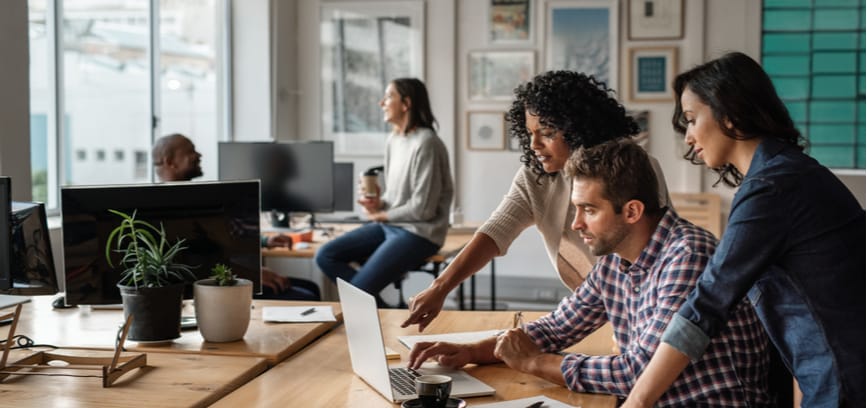
At Axiom, we agree that the office will look different. Rather than having a majority of people in the office working from a desk, we will see more breakout spaces, team spaces and collaboration hubs – workspaces where people can safely gather to exchange knowledge and ideas. While this hybrid model of work was already on the horizon, the pandemic has undoubtedly accelerated the timeline.

A look into the future

During our Future of Work webinar, the panel discussed the trends they are noticing in workplace wellness and wellbeing now and into the coming years.

First, let us introduce the speakers:

The financial impact of wellbeing

Although workplace wellbeing programs aren’t new, the COVID-19 era has ushered in a new awareness of how employees’ health and wellbeing has a material effect on a company’s bottom line.

“It hasn’t been appreciated until now, but a healthy and well workforce creates a healthy and well organisation,” said Jack Noonan.

Making the invisible visible

The past year has been about “making the invisible visible”, explained Jack. Whether that’s the COVID-19 virus no one can see or instilling confidence in a workforce to return to the office, the focus has been on making those invisible things tangible and actionable. Jack also pointed out that sensor technology is trending for validation and verification of things like air and water quality – all circling back to building employee confidence in their health and wellbeing at work by making the invisible visible.

Focus on health equity

While pre-COVID workplace wellness programs existed, the percentage of people who opted in was low at 20-40 percent, said Jack. And most of the time, those people were the ones who needed that intervention the least. This was a concern then, but the concept of ‘health equity’ has been fast-tracked post-COVID.

What is health equity? The World Health Organisation defines it as “the absence of unfair and avoidable or remediable differences in health among population groups defined socially, economically, demographically or geographically”. In the workplace, this means that workplace wellness needs to be for all people – not just those who opt-in. In practice, this means putting health and wellness into leadership and policy.

As Josh Lambert said, “wellbeing needs to have equity of access for all” – it’s now a necessity and “there is a duty of care on employers to provide a well workplace”.

Preventative action

“The reality is that 98 percent of health spending in Australia is on treatment. Less than 1.5 percent goes to prevention. Yet 35 percent of chronic diseases in Australia are preventable,” said Jack.

He pointed out a huge opportunity here for workplaces to help prevent illness with proactive wellbeing programs and initiatives.

A culture of health

People are actively looking for ways to improve their health, according to Eminè Mehmet. Since the pandemic outbreak, she explained, the population has become more knowledgeable on what needs to be increased and enhanced at work for their health. 

Josh noted that we see this demonstrated in the workplace with the rise of the Chief Wellness Officer (CWO). “Employees are driving change with their demand,” he said. 

This shift in narrative drives a ‘culture of health’, where old ways of working are broken down with a more coordinated and collaborative approach to health across organisations. Jack illustrated this point by describing the surge in meetings between the heads of facilities and the heads of HR. 

Your top 5 workplace wellness goals

The Future of Work webinar wrapped up with our panel describing the high-value areas to spend your energy and budget on:

1) Building wellbeing into strategy

Wellbeing needs to be more than just values pinned on the wall, explained Josh. It needs to sit within the overall business strategy and be supported by a health and wellbeing culture.

2) Promotion and branding of wellbeing initiatives

“There is no point having a program on paper if it’s not promoted and branded internally,” said Josh.

“Give the program a persona or brand to create awareness. The initiative will only be as good as the awareness of it.”

3) Air quality

Unsurprisingly, Eminè recommended we turn our focus to the air quality in our workspaces. In fact, the adoption of technology that measures air quality is increasing, including airborne particle monitoring. 

4) Engagement with employees

In order to create something significant in the wellbeing space, you must engage with your employees to find out what they need. Eminè noted that any wellbeing initiative “needs to be specific to your people for it to be used”. She explained that a company culture of openness and willingness to listen is needed for any engagement to be successful, otherwise people will not speak up. 

5) Monitoring and measurement

Fifty-seven percent of our webinar audience said their organisation doesn’t currently measure how their physical workplace supports people, productivity and culture. Yet, as Jack explained, “You can’t manage what you don’t measure. Small or big.”

Annelie Xenofontos added, “You have to hit the handbrake. Go back to what the objective is, then engage in the design to create the right space.”

Want to explore more about what the future of work might look like in your workplace? Examine the four fundamental elements of the future of work – people, process, place and tools – in the Future of Work: A Progressive Leaders Guide To Staying Ahead.

Workspace design trends shaping the future of work in 2021

Workspace design trends shaping the future of work in 2021

It’s 2021, and the office’s role has changed. COVID-19 has accelerated the future of work and quickly evolved the way office spaces need to function. Workspaces are feeling more like safe, homely spaces, enticing employees back into the office environment.

Naturally, this sees some interesting trends emerge in workplace design: greenery and green credentials are increasingly important, designs are incorporating virtual connections more than ever before, the unpredictable environment is driving flexible, agile spaces that are ready for anything.

Let’s explore what these 2021 workspace design trends look like in practice.

Workplace design trend 1: Make it feel like home with resimercial design

Resimercial design mixes residential and commercial characteristics to create a workspace which feels ‘homely’. The trend began as the Millenial and Gen Z generations entered the workforce. They grew up with technology which enabled the notion of working anytime and anywhere and with that came new expectations around the workplace – comfort, convenience and warmth. Of course, the pandemic accelerated the trend as more and more people began working from home for a significant amount of time and now prefer certain creature comforts in the workplace too.

Done right, resimercial design introduces employees to natural daylight, freedom to choose where to sit and flexibility around where work is done. On a more surface level, expect to see more comfortable furnishings and decorative additions usually associated with the home such as soft furnishings, warm lighting, framed wall decor and a more domestic colour palette.

Professional office features are still critical; quiet spaces for deep work, private places for phone conversations, meeting rooms and practical lighting.

Workplace design trend 2: The greener the better

The humble office plant isn’t new, but in 2021 expect to see greenery taken to the next level as the focus on employee wellbeing continues to grow. Biophilic design isn’t just about a pot on a desk – although that’s a good start. It is about introducing nature more profoundly into internal and external design, to reconnect with nature and bring the outdoors in. Think living green walls, plant partitions (a more aesthetically pleasing take on the perspex screens which have almost become ubiquitous), indoor office gardens and even marine ‘gardens’, complete with fish, built into seating or breakout areas.

Nature is well known to boost mood, reduce anxiety and stress, and improve air quality, promoting employee health and wellbeing outcomes.

It’s not just about the plants though, green design goes further, extending to more sustainable office design. Employers and employees are more conscious than ever about their environmental impact. In 2021, expect to see more sustainable materials being used in office design and innovative solutions to encourage greener choices within the workplace.

Workplace design trend 3: Virtual first

Videoconferencing technology has played a vital role in the past year to facilitate connection and collaboration. While most offices have reopened in Australia, there have had to be concessions made with physical distancing and a general shift to more flexible ways of working. The physical workplace has had to adapt.

Expect to see:

  • More screens (multiple in meeting rooms to patch in remote workers), cameras and microphones
  • Smart interactive whiteboards for onsite and offsite collaboration
  • Design that promotes good acoustics for effective conferencing
  • Small and private designated video conferencing rooms

Workplace design trend 4: Focus on design as part of your employer brand

We’ve always believed that office space is an extension of your brand’s DNA. And in 2021, more and more companies are using their workplace’s design to strengthen their employer brand, and attract and retain top talent.

No longer are offices only seen by employees or those who make it to the recruitment process’s interview stage. Now workplaces are showcased across social media as Millenials and Gen Z share their offices on TikTok, Instagram and Snapchat. Add to this the screen time your office gets via webinars or how it is reviewed on sites like Glassdoor, and it’s clear that your workplace needs to put your brand’s best foot forward.

Every day we help businesses to leverage and showcase their employer brand through their office design – take a look at some examples.

Workplace design trend 5: Movable and modular furniture

In 2021, office design can’t afford to be stagnant or fixed. For it to be practical and responsive to evolving requirements, it needs to be flexible. Physical distancing, split shifts, and hybrid work arrangements have all magnified the growing need for more flexibility in the workplace.

Expect to see modular furniture that can be moved and adjusted to suit distancing requirements or new working patterns. Movable desks, chairs, partitions and walls, and even whole cubicles will make up the new flexible office design.

Want to look beyond 2021 in workspace design? Find out more wit the Future of Work: A Progressive Leaders Guide To Staying Ahead.

The future of work and how it's impacting company culture

Almost a year on from the start of the COVID-19 pandemic, we are starting to see the impacts of the crisis on workplace culture in Australia and it's clear that the future of work is being reshaped. But although the picture is coming into more distinct focus, the long term effects probably won’t be apparent for years to come.

What we do know is that the workplace, the workforce and the way we work have significantly and permanently changed. Lockdowns and travel bans have flipped what we thought about the nature of work altogether. Businesses have seen that employees don’t necessarily need to be in the office to get particular work done. Remote work has become the new norm. Commutes have been cancelled. Business travel superseded by Zoom meetings. So as we adjust to these new working ways, leaders must consider the effects this is having on company culture.

What is company culture?

Company or organisational culture is made up of every interaction within your business. It’s the processes, decisions and conversations held within your office and also what is played out online. In a recent webinar Axiom hosted, culture was likened to the body’s immune system. There to support the body, but if not treated well or looked after, it can fail or, in fact, attack.

Company culture is critical as it guides behaviour. It tells employees how to respond, what choices to make and how to handle tricky issues. Company culture is the unseen force which drives employee decision-making day in, day out. Culture tells employees what to do when their leader is out of sight.

How do we shape culture?

So if culture is this nebulous, almost unseen thing, how can leaders shape and improve it?

Before making any change, it is essential to understand your culture first and from there identify what you want to achieve. Without this initial understanding and vision of where you want to be, it can be easy to lose sight of the end goal and get stuck in business as usual.

In a recent webinar we hosted, it was mentioned that the higher you go up the corporate ladder, the less that person actually understands what the culture is within an organisation. So as businesses get bigger and organisational structures become more vast, so does the challenge of truly grasping what the company culture is like.

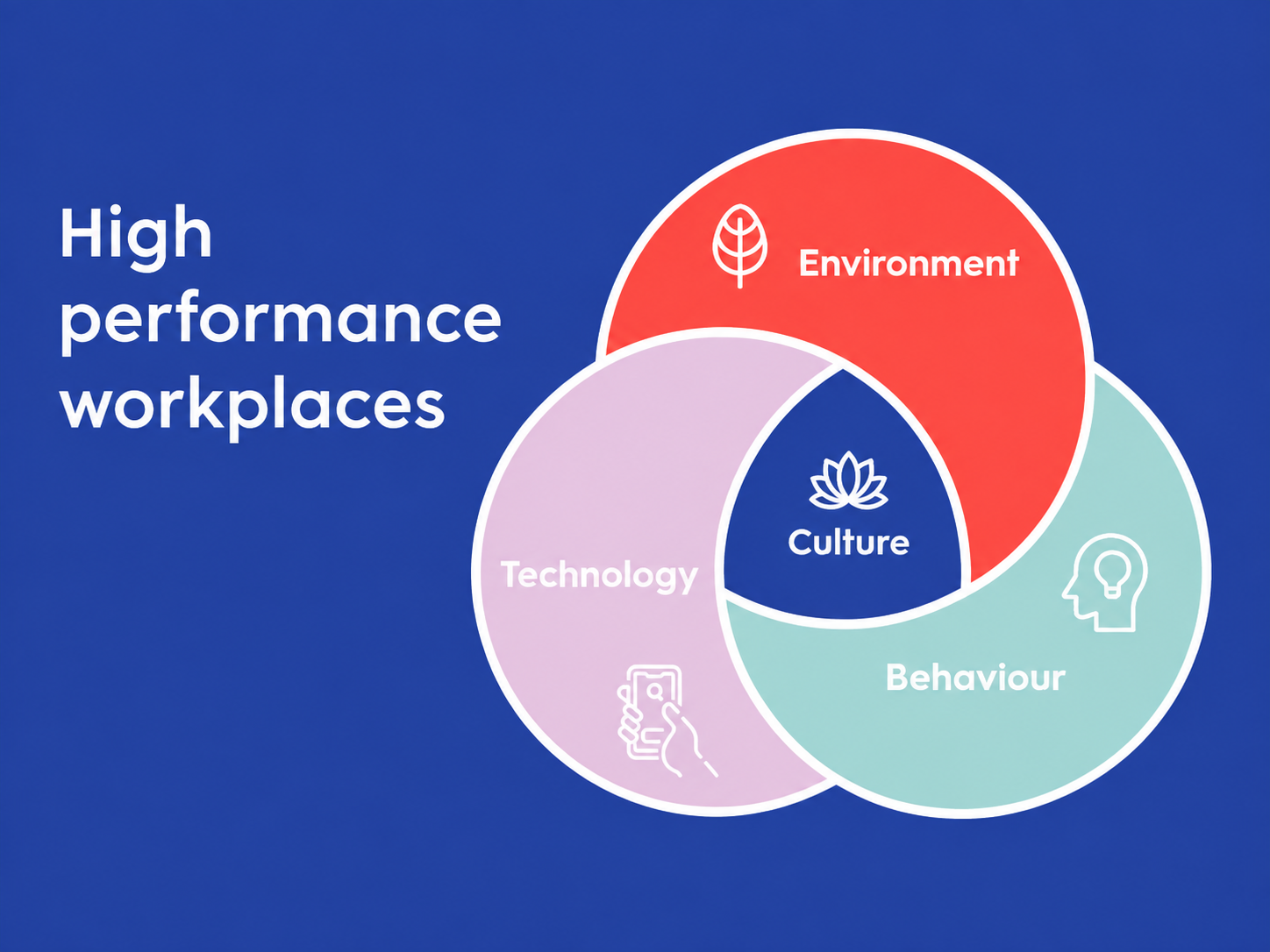
To help you get an understanding of your company’s culture, we’ve broken down what the culture of a high-performance workplace consists of:

High-performance workplace

We see company culture as an amalgamation of a few key things: Technology, Environment and Behaviour. These areas are interwoven, inextricably linked, and the building blocks of organisational culture.

Technology

Technology is a driver and enabler of culture. It provides the ability for seamless connections and also to make location agnostic. It fosters collaboration amongst teams and allows them to remain productive, whether in the office or remote. And while technology has been vital to the work from home shift during COVID-19, it’s just as important in the physical workplace. A bad technological experience, no matter the location, is remarkably detrimental to culture.

Environment

In a recent webinar Axiom hosted, we polled the audience, and most people said they plan to modify their existing physical office in response to the shift in working style we’ve seen over the past year. This is the perfect opportunity to think about how the physical environment can support and improve your company culture.

In our new hybrid working environment, it’s essential to consider how people are working in the co-located office. What tasks are being performed? How can the environment support those tasks specifically?

The other thing to consider is, now that people have the option to work from home, how can the physical office be designed in a way to attract staff back in?

To answer these questions, it’s essential to get to know your people by immersing yourself in your organisation. You need to understand your people, the type of work they do, and where and how they can do it best. In general, an office is a place of connection, learning, collaboration and socialisation, and designing the space to support these key elements will support strong company culture.

Behaviour

Behaviour is an obvious part of the company culture ‘pie’, which ideally should be underpinned by strong organisational values. The values held by employees on the inside will be reflected by their behaviour on the outside. However, creating company values, printing them on posters and sticking them on a wall is not good enough. Values must be role modelled from the top and built into the way business is done. Action must follow words, or company culture will suffer.

How has COVID-19 affected culture?

COVID-19 was a moment of truth for workplace culture in Australia. Businesses with robust, resilient and positive cultures are in much better positions than those with weak or negative cultures. In our last webinar, our panel noted that there had been a few common cultural themes highlighted over the pandemic. Let’s start with some positives.

For many employees, the move to remote work was an opportunity to get comfortable being more personal and open with colleagues. Work from home has been a window into people’s lives which wasn’t available before. Connections have become more genuine, and employees have felt they can be their whole selves.

Interestingly, given greater physical distancing, closer collaboration, and a willingness to jump in and help colleagues has also developed. This perhaps due to the “we’re all in this together” attitude that’s permeating companies.

The shared struggle has also seen an increase in empathy and understanding between colleagues, employees and employers. Before the pandemic, problems were usually individual and left at home. Now, everyone is weathering the storm, and the home is a genuine part of the workplace.

On the flip side, pandemic-induced isolation and job insecurity have unsurprisingly hurt employee wellbeing. Employees are struggling to switch off and set boundaries between work and home life.

Physical distancing, the rise in remote working and working in shifts also means less incidental, serendipitous meetings. These “water cooler” chats are often the catalyst for innovation, fresh ideas and collaboration, and we’re yet to see the true impact of missing out on them.

What is a cultural continuity plan?

Just like a business continuity plan, a cultural continuity plan is about making it through a crisis or navigating change and coming out the other side strong. It’s important that your business has the ability to translate what is important to the company (i.e. mission, vision and values) no matter what is happening externally or internally in order for your culture to be preserved.

Your cultural continuity plan starts with an outline of the things that are important to your company’s culture. Then it needs to address how these things will be protected when a crisis, like the pandemic, occurs. For example, if your business values social connections, and this usually looks like Friday night drinks at the pub, what will this look like in a lockdown situation?

How does the physical workplace affect culture?

As you now know, the environment is an integral part of the company culture ‘pie’. While it is only part of the equation, if you have a physical workspace, it is essential to building and supporting a thriving company culture.

However, we’ve found that most companies are not measuring how well their physical workspace supports their people, productivity and culture. Measurement is key to objectively interpret the progress of your company culture. Without proper measurement, you cannot see what’s being done well, what’s being done poorly, and where there are opportunities for improvement.

This is why Axiom developed the Workplace Thrive Index, a tool which will take the pulse of your organisation. Once the pulse has been taken with a carefully facilitated process, the Index score is measured against industry benchmarks and areas for improvement are determined. Want to know where your organisation sits on the Workplace Thrive Index?

Company culture is an essential part of the Future of Work, explore other considerations in the Future of Work: A Progressive Leaders Guide To Staying Ahead.

The office of the future: Transform your workplace for changing space requirements

The office of the future: Transform your workplace for changing space requirements

The pandemic has accelerated a range of pre-existing workspace trends around health and wellbeing, flexibility, activity-based working and the demand drive for better space utilisation. With this change in working habits, the requirements of COVID-19 workplace design have come into focus.

Things like high quality virtual connective hardware which were once on the “wish list” are now office must-haves. Some of these investments are now also within reach, thanks to boosted tenant incentives.

In this article, we’ll explore the new requirements of the office as well as the incentives on offer to fund these essential upgrades.

The new office must-haves

Right now conflicting forces are pulling at the future of office footprints. One is the need for more space to accommodate physical distancing protocols. The other is the need to reduce space with more people working remotely. In a post-vaccine world, physical distancing requirements will cease to exist, but the changes to the way people work are here to stay.

While technology has proven valuable to support and maintain collaboration and interaction in the required work from home period, long term it will complement but not replace the need for a physical workplace.

Long term, workspaces will have a rationalised physical footprint, and be comprised of flexible well-equipped spaces designed to support specific employee needs. The new office will have technology built in (eg. occupancy sensors or smart lighting solutions), a strong focus on health and wellbeing, plus a workplace design that is sympathetic to the productivity needs of employees while they’re in the workspace.

Entice employees to the workspace

Enhanced productivity, no commute and the opportunity to work in leisurewear – working from home has a lot of perks the office now needs to compete with. The new workplace needs to become a destination with a purpose which entices employees to return.

The office will need to offer more to employees than just a workstation to sit at for 8 hours a day. Rather, smart businesses will create places that attract and retain their employees with careful workspace design.

Employee health and safety

The new office puts employee health and safety front and centre. Workspaces will take advantage of technology and equipment such as hands-free or easy to clean materials (non-porous surfaces) and fixtures (automatic doors and taps) to rebuild employees’ trust and confidence.

Seamless connection between physical and virtual

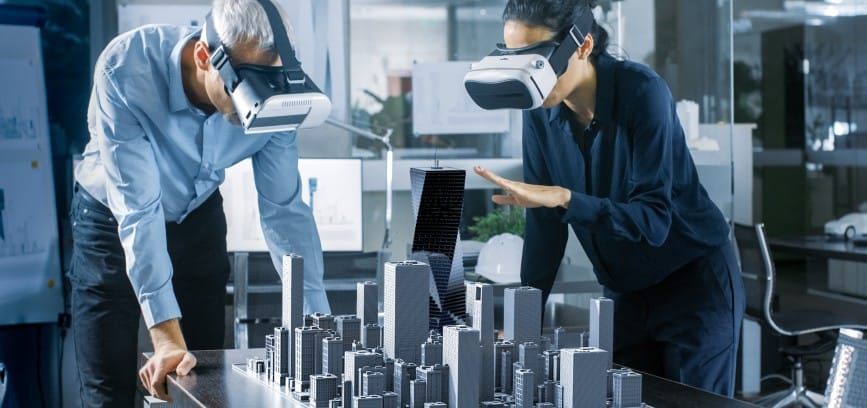
Remote working isn’t going anywhere, which means the new office needs to be reconfigured to accommodate technology upgrades. Meeting rooms need to be equipped for seamless video conferencing, whether that’s with better quality screens and audio or faster data connections, to ensure flawless links between those out of and those in the office.

Collaboration and connection spaces

A key purpose of the new office is connection and collaboration between employees. With focussed and deep work done from home, employees will increasingly visit the office when human interaction is required, and the workspace needs to encourage and support this type of work. In a pre-vaccine world, these spaces will need to consider movable furniture for safe distancing and acoustic treatments which aid conversation across distance.

Use tenant incentives to create your new future-proof office

According to the Property Council of Australia, Australian office vacancy increased over the first six months of 2020 for the first time in four and a half years to 9.5%. This has created a pro-tenant market, and as landlords work to keep building values steady in a turbulent time, they are offering incentives to tenants like:

  • Rent-free periods
  • Rent abatement
  • Fitout contributions
  • Changes to rent review and make good terms

While tenant incentives aren’t new, they are currently on the increase. CBRE notes that in Sydney, “incentives are on the rise to encourage leasing activity in the market, nudging up around the 30% mark.” In previous years, this sat at 18-20%. It is a good time to take advantage of the increased incentives to fund your future-proof workspace upgrades.

Wondering what other future of work trends are affecting workspace design? Check out the Future Of Work: A Progressive Leader’s Guide.

Activity-Based Working in the post pandemic era

While many employees have worked from home since March, companies are now planning or are amid their return-to-office strategies. Although we may be returning to the office, the pandemic has changed the way we work forever. The current affairs have also provided an opportunity to redesign and reimagine your office space with an Activity-Based Working strategy while still prioritising employee health and safety.

The journey towards activity-based working

Activity-Based Working (ABW) has been around since the 1980s but grew in popularity during the 1990s as more companies implemented activity-based working throughout their offices. And although at first glance it may appear that the pandemic may have halted the trajectory of ABW, it really couldn’t be further from the truth.

ABW is a style of workplace design that enables employees to choose the best environment to suit their individual working style. So rather than sitting day-in, day-out at an office desk, the employee can change it up depending on what task they’re doing – whether that’s collaborating with others in a brainstorming space or working from home for deep work.

ABW is commonly confused with hot-desking, which removes allocated seating to inspire mobility and maximise office space. But it’s more than that. ABW is about supporting employees while they’re in (and out of) the office, so they perform at their best every day.

How the pandemic has changed the requirements of the office

COVID-19 has been a catalyst for many organisations to rethink how ‘work’ gets done. And it has started many on a path to trusting and empowering their employees to work where and even when they work best.

Given one of the critical tenets of Activity-Based Working is the empowerment of the employee, it’s clear ABW is an excellent match for the future workspace. Naturally, challenges to working in a shared space in the pandemic-era have arisen. Let’s explore their solutions.

Physical distancing

Keeping 1.5 metres apart in a shared workspace is a challenge all companies face as they have employees return to the office. An ABW design has the flexibility to accommodate distancing requirements physically in the office as well as by empowering employees to work remotely when needed. Consider capacity based on physical distancing guidelines and plan ahead for those coming into the office – A/B shifts or flexible working hours can help.

High contact areas

In any office, whether ABW or not, there are high contact areas like light switches and elevator buttons which need to be considered. In the first instance, a frequent and thorough cleaning schedule for these areas will need to be implemented. In the longer term, consider touchless technology or automation to avoid contact altogether. Shared spaces like kitchens, bathrooms and thoroughfares also need to be considered. Wayfinding and physical distancing signage can be helpful to keep employees moving in the right direction and maintaining a proper distance from one another.

Provide employees with their own equipment like keyboards or headsets, so they are not shared between coworkers. Also, ensure cleaning and disinfecting supplies are readily available for employees to use as required between scheduled cleaning. Additionally, make sure there is enough time between workspace handover to allow for cleaning and disinfecting to take place.

Technology solutions

Besides the physical workplace, employees also need an efficient digital working environment, affording instant access to all important information, anywhere and at any time. As well as the technology tools to efficiently collaborate with colleagues, wherever they may be. Technology solutions we are keeping a close eye on are:

  • Space utilisation software: Used to optimise how people interact with their flexible work environment.
  • Environmental health and comfort: Sensors used to monitor things like temperature, humidity and air quality for a comfortable and safe working environment.
  • Personal wayfinding: Occupancy sensors used to gather data and create interactive floor plans on kiosks or mobile apps.

Thanks to its nature of flexibility, with the right planning, ABW means your employees will return to a responsive, adaptive, modern office which they are confident will keep them safe and well.

Wondering how else COVID-19 has changed the future of work? This is one of the topics we explore in A progressive leader’s guide to the Future of Work in Australia.

Flexible working and wellbeing in the future workplace

Flexible working and wellbeing in the future workplace

The future of work has been forever changed. As we begin to return to work post COVID, organisations are starting to reflect on the sudden and involuntary uptake of flexible working models from early 2020. Such models have, perhaps permanently, shifted expectations for employers and employees – thanks to the experience of unforeseen benefits for both. 

The benefits of co-located, or office-based working still remain, however – connection, collaboration and culture are still key to organisational success and cannot be completely replaced with remote model variants. As organisations have now realised, a hybrid model of work is the most likely outcome of the pandemic – an extension of activity-based working, where some work is suited to the office, and other work is suited to the home. 

This makes quality workplace design crucial as a way to placemake workplace environments, and ensure that they optimise employee wellbeing. 

How workspace design can aid in employee health and wellbeing as we return to work

Flexible workplace design isn’t a single standalone tactic – it is made up of a whole spectrum of tools that can be deployed to improve productivity and the wellbeing of staff. It can be leveraged across so many workplace aspects – from the physical design of the office to the spaces employees use to complete the work and all the way through to the flexible work hours the organisation offers. 

Designing a workplace to support flexible working has been shown to improve employee wellbeing, in fact, employees tend to be happier in flexible working environments. Some of the benefits include:

Honing in on the purpose of your office space 

The office of old was all about squeezing people into small, permanent spaces – ensuring everyone is together and that firms can also keep their real estate costs down. More recently, this strategy has begun to shift, and the pandemic has accelerated workplace design towards a more flexible use of space.

In a post-pandemic world, the office is about celebrating the reasons we come together. Some of the common purposes for co-located work include collaboration, social interaction and learning and development, but each organisation will have its own unique requirements. 

The future workspace understands and caters to the specific work purposes, which in turn can augment a sense of employee wellbeing. Here are just some of the dials that can be turned to provide a safe and productive place for co-located work. 

Choreographing movement

In flexible and agile work environments the choreography of movement has always been an important factor of workplace design. In a world that includes physical distancing requirements, this ‘dance’ has become even more imperative. 

Directing movement through design with wayfinding (whether it’s signage, structured paths or colour coding) gives employees simple signals as to where they should walk, stand or sit – keeping themselves and others safe and healthy.

Leveraging smart office tech

With smart office tech, workplaces can support the flexible use of space and optimise utilisation. Whether it’s enabling data-driven facilities and building management or creating a touchless experience for employees and guests. 

Like with many things, the technology to do this already existed but COVID-19 has accelerated the adoption of tech like sensors, room booking systems and occupancy planning tools.

Considering digital and social inclusion

In a traditional working environment staff were able to demonstrate care and connection through in-person interactions: saying hello on entering the office, having coffee with a colleague, celebrating a work anniversary in the shared kitchen. In a flexible work environment where some employees are co-located and some are working elsewhere, inclusion becomes more of a challenge.

Businesses, leaders and teams have an opportunity to introduce new, valuable practices and spaces to ensure the inclusion of those not in the office, such as virtual social events (trivia night anyone?) and well-designed meeting spaces which cater seamlessly to those connecting virtually.

Deploying biophilic design

In a report, psychologist Sir Cary Cooper explains the relationship between workplace design and biophilia as “an innovative way to harness this affinity in order to create natural environments for us to live, work and learn [in]. By consciously including nature in interior or architectural design, we are unconsciously reconnecting; bringing the great outdoors into our constructed world.”

To sum it up, workplaces that incorporate natural plant life are inclined to be happier, more productive spaces.

Managing acoustics

Open-plan offices have often been discredited as noisy and unproductive spaces, yet good design will allow the flexibility of open plan to exist without acoustic downfalls. Careful acoustic design can overcome acoustic shortfalls by using materials which absorb excess noise to enhance communication between teams, reduce disturbance from undesired noise, improve privacy and allow employees to focus on tasks that require concentration. 

Letting in the natural light

A survey published in the Harvard Business Review shows that access to natural light is the number one thing employees want in their office environment. And for good reason.

Research by Cornell University strengthens the relationship between natural light and employee wellbeing. A study found the optimisation of natural light in an office significantly improves health and wellness among workers. 

A design based on flexible working principles will allow workers to have access to natural light as they choose the space best suited to work in for themselves.

Despite new models of work becoming prevalent, the benefits of a central workplace – connection, collaboration and culture – still remain, and are key to organisational success. Workplace design plays an even more important role today, in placemaking creation for organisations that want to thrive with a hybrid model of work – but also in nurturing an employee’s wellbeing while they are onsite. 

The future of workplace design is changing and evolving as we speak. With so much information on the future of work, we wanted to help by collecting the most crucial future of work knowledge in one place for you to access easily. Check out all you need to know about the future of work here.