Destination workplaces and the future of work

Destination workplaces and the future of work

With remote working now the norm for many workers in Australia, employers are facing the challenge of how to encourage their employees to return to the office space that they still own or lease. But when everyone has a desk at home, how do you convince people to make the commute?

While there’s much talk about ‘enticing’ people back to the office with incentives and perks, many of these short-term solutions fail to acknowledge that both the way we work and the role of the office have fundamentally changed. A new value proposition for office working is required, one that involves a rethink of the modern workplace and the future of work, complete with increased virtualisation for hybrid workforces.

Many experts in workplace design are calling this The Era of the Destination Workplace. In this article, we’ll explore what this means and how you can start creating a destination workplace today.

What is a destination workplace?

Now that coming into the office is no longer compulsory, most traditional offices hold very little appeal for many employees. If you want to entice your people back to the office, a Destination Workplace is what you’ll need.   

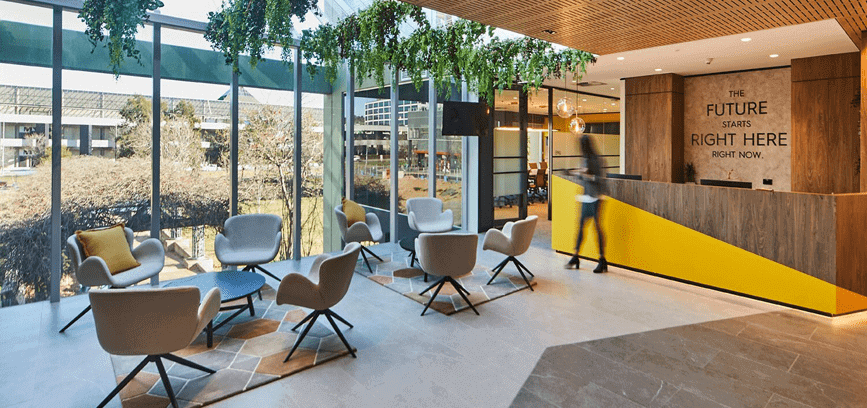
The Destination Workplace is a place where employees actually want to be. It’s not simply desks in an office that people are required to be at from 9 to 5, a few days a week. They’re work environments that use concepts of placemaking, that is, paying attention to physical, cultural and social needs to add genuine value to your teams’ lives while enabling their work product. And the widespread adoption of flexible and hybrid working practices has driven a steep incline in popularity.

“We need to reconstruct a workplace to be really valuable to people – to provide functionality that enables us to work in the way we want,” said Cassandra Kirk, Head of Design and Strategy at Axiom Workplaces.

This now also means creating workplaces that offer what cannot be experienced at home – such as spaces that are great for innovation, collaboration, socialisation, and events.

“We’re now coming to the office to do things that are only relevant to being in the office. If we can do an activity at home, then we can choose to do so,” said Cassandra.

By creating a destination workplace that complements the advantages of remote work with the unique benefits of office work, you’ll draw your workforce back to the workplace – not necessarily full-time, but in a regular, purposeful and productive way.

So how do you do this?

4 steps to create a destination workplace:

1. Reallocate spaces

Now that we no longer need large spaces to provide everyone with a desk, business owners can use their square meterage more creatively – or even downsize to save money.

“There’s an opportunity for employers to add varied workspaces that they always wanted. Now they’re no longer limited by their space or financial means and have more flexibility, many can achieve this dream,” said Cassandra.

So if you’ve always wanted a tailored event space with a full kitchen for catering, or break-out collaboration spaces with soft chairs and whiteboards, or even a library for quiet work or inspiration … Now’s the perfect time! 

2. Create more engaging spaces

Placemaking has long been associated with creating a sense of community, and new workplace design trends are being heavily influenced by this, according to Peter Black, one of Axiom’s Workplace Strategy Consultants.

“Towns generally have a heart area – a hive of activity – and then quieter spaces that radiate out from that,” explained Peter. “They’re centred around a particular attraction, such as fine food.”

In destination workplaces, this may look like a social centre that has a cafe vibe, or an innovation hub with the best interactive whiteboards and relaxed, comfortable seating.

“It’s not only about functionality,” added Cassandra. “It’s also about creating a wow experience – a magnetic appeal that draws people in.”

The benefits are not just for employees. As people talk about their workplaces and find them enjoyable places to be, this creates an energy that is associated with your business and can attract new talent, benefit your brand and encourage potential leavers to stay. 

3. Create more inclusive workplaces

No two employees are the same, but our work environments have typically not catered well for these differences – whether related to geography, working style, caring responsibilities, disability, or illness. However, when you give your workers more choice in where, when, and how they work, you create a more inclusive workplace.

“The ability to structure your day – to work in the way you want – is great. It’s inclusive and opens up roles to more people,” said Peter. “But it does mean that placemaking is a really important part of the office in order to create a purposeful space that people want to be in.”

This is where destination workplaces come in – as a complement to remote work, offering its own unique benefits. By creating an office that people want to be in and that enables different types of productivity, you actually provide your employees (and potential employees) with more options to choose work conditions that suit their daily needs.

So whether it’s dedicated rooms for team collaboration, sound-proofed phone booths for video calls, or breakout spaces for those needing 10 minutes to clear their heads, ensure that your destination workplace can inspire and expand the ways people can work, rather than limiting them.

4. Don’t forget virtualisation

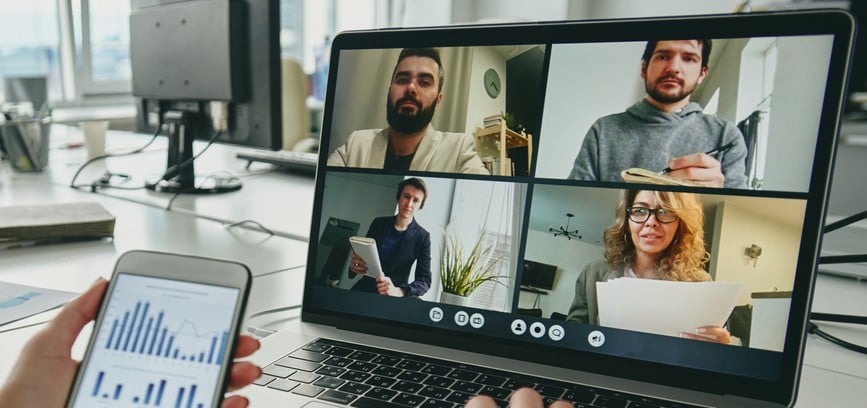
Lastly, don’t forget to cater for the increased virtualisation we’re seeing in work. Even if employees are coming into the office, they will likely still have colleagues who are working remotely. So ensuring that your new destination workplace caters to this with increased spaces for video calls, screens and speakers in all meeting rooms, is critical.

If you’d like to learn more about the new role of the office in the future of work, read the Future of Work: A Progressive Leaders Guide To Staying Ahead.

Design File: Axis Communications

Design File: Axis Communications

Axis Communications is an integrated technology solution provider that manufactures network cameras for the physical security and video surveillance industries. They offer solutions based on sight, sound and analytics to improve security and optimise business performance for their customers.

Before Axiom…

Axis is in the process of shifting their brand from being a security hardware provider to a company that provides integrated technology solutions. With a 10-year lease in their large space, Axis was ready to transform their workplace to align with their new vision and direction.

The brief was a high-energy workplace that seamlessly connected staff inside and outside the local office with collaboration spaces and best-in-class communications technology. All of this was to happen within an expansive, yet personalised, experiential environment. 

The business had a unique opportunity to create an Experience Centre, a multi-purpose space that showcases leading-edge technology to clients as an experiential journey. The brief was to use design to finely balance seemingly opposing constructs of cutting-edge technology with a welcoming, friendly feel.

After Axiom…

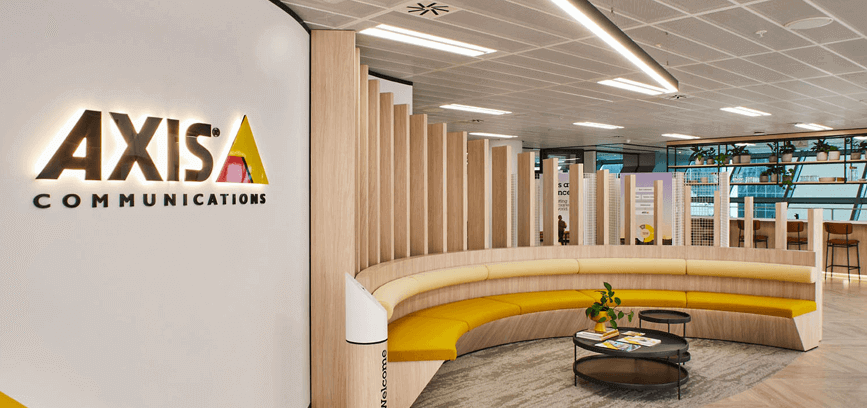
With the journey as the central design concept, we designed the Axis Experience Centre as a sequence of client experiences that visually guided clients. 

The experience begins with the arrival – an energetic welcome, with a dramatic and tech-inspired back-lit foyer. As the explorer proceeds throughout, they find the showcased technology embedded in softened colours, textures, and environmental graphics. The Experience Centre enjoys natural light and the space features a prominent social gathering area, instilling an immediate connection with both people and the outside environment. 

“The Axis team wanted its front-of-house showcase to be experienced as a journey – one that finely balanced the seemingly opposing constructs of cutting edge technology with a welcoming, friendly feel”. – Annelie Xenofontos, Senior Associate Strategy

Based on the concept of The Golden Mile, we deployed a range of integrated design techniques to guide the journey including colour-blocking to highlight different aspects of the narrative, backlighting for visual effect, angled linear lighting for dramatic effect, reflective finishes and textural play for interest and energy, as well as 3d wayfinding.

An equally inspiring journey has been created for staff. The team space features a large break-out space that capitalises on the view (with the hallowed MCG to the left and Port Phillip Bay to the right) and offers ample amenities while featuring varied work points, focus spaces and collaboration spaces. 

“Meanwhile, back-of-house was endowed with diverse yet well-connected work points, multiple collaboration areas as well as access to the view and all amenities”. – Annelie Xenofontos, Senior Associate Strategy

This was a job of balance and connection, bringing function and design together into a seamless journey for both clients and staff. 

At a glance

  • Two spaces, distinct, yet connected, technologically enabled, yet welcoming
  • Simple Scandi-style design, consistent and complementary to their headquarters in Lund, Sweden
  • Longevity and low maintenance in both design and materials
  • Used sustainable products and materials to complement their  6-star green building and a 5-star NABERS rating

Ready for Axiom to work their workplace strategy and design magic on your current or new office space? Book a free virtual consultation today to see what we can do for you.

Axiom Workplaces combines your commercial fitout and workplace design goals with our experience and expertise in evidence-based office design to create a thriving workplace for you and your workforce.

Does your workplace reflect your company culture and values?

Does your workplace reflect your company culture and values?

As people begin returning and spending more time in the office, employers have to make sure that the physical workspace keeps everyone engaged and productive. They not only need to create a company culture that is safe and supportive, but one that also aligns with the company’s purpose and values

In this blog post, we look at how you can design a workplace that effectively communicates your values to your team, clients and customers, and why this is important.

How your workplace design can communicate company values

Company values are more important than ever—they set the tone for how employees communicate with their clients and each other and more—but if they’re not communicated well, businesses won’t be able to realise the benefits they bring.

The office is not just a physical space to do work. It’s not just an area with walls, desks, rooms and windows. An office is a place where people can collaborate, socialise and share ideas, views and aspirations. And the actual design of your workplace can have a significant impact in creating a supportive, engaging and productive culture

Workplace design creates an environment that supports your brand and tells your story. Each design element can communicate to employees, clients and customers the core values that represent who you are as a company. 

Here are some steps to make your workplace design reflect company values.

1. Define your company values

The workplace design process doesn’t start with choosing the right colours, lighting or layout. It begins with defining and establishing your core values. This is an opportunity for your business to refocus on your mission as a company, determine your ‘why’, and review the values and principles that are essential for both management and staff.

This is a critical step in the process – and should not be skipped. It builds the foundation that guides the way forward. So, take the time to re-examine and define your company values before you start thinking about how to translate them into the physical workplace.

2. Design the workplace to reflect your values

When you have defined and established your core company values, it’s important to communicate them across the whole business. Conduct company-wide presentations and team workshops. Email your values to each employee, and have team managers lead the way in practising those values. 

One important aspect in this step of the process is to have a look around the office and review the physical workspace. Does your office interior design reflect your company values? If not, you’ve missed an important opportunity to communicate your values internally and externally.

Let’s take a set of example values and talk about how we could create a workspace to align and promote them. 

Company values: Empowerment, Real People, Innovation and Customer-Centric.

  • Create a front of house area that is prominent and purposely designed to host clients and external visitors to ensure being customer-centric is clear to all. Continue on with this theme by choosing a higher level of finish and furnishing and mood lighting, artwork to emphasise the importance of visitors. More specifically, the choice and style of furnishings also need to portray the appropriate tone and language to anyone who visits your office, e.g. timber veneers and the use of a reasonable amount of glazing reinforces trust and transparency, but also may delineate front of house from back of house, assuring your clients that their IP protected when you work for them.
  • Using seamless technology connections focuses on the values of customer-centric, innovation and making the design for real people. How does this work in practice? By designing a workplace where employees can drop into unbookable spaces to accommodate a client that has arrived unannounced and needs a quick meeting. The employee can book the space at the door of the room for 30 minutes with no fuss and hassle, making the experience great for the client. Need to connect to the AV and dial in a virtual team member? No problem. It’s all done at the touch of a button and intended to accommodate and facilitate the client’s needs empowering everyone to collaborate efficiently.
  • Include ‘experience centres’ to address innovation and customer-centric needs by facilitating a curated experience for people. How? Design for creative sessions, change the lighting, allow writing and sticking onto all walls, use modular furniture and a variety of settings within a room to create a sense of innovation when combined with high tech solutions in lighting and VC/AV equipment.
  • Include right-sized, placed and styled collaboration, entertainment and social spaces to empower employees to host client-centric meetings and workshops that treat everyone like real people.
  • Design social spaces that accommodate employee activities – keeping it real for them in how they connect their support services, reinforcing that real people connect with their real needs being met. It might be as simple as a functional kitchen layout with enough recycling bins, sufficient microwaves placed correctly and free access to the filtered water tap without having to impede the packing of the dishwasher.
  • Provide choice in work settings i.e. flexibility about when you are in the office to choose the most productive work setting in order to empower and enable customer-centric responses by cutting down response time.
  • Include sufficient focus and quiet spaces – this again means real people are getting their real needs met and enables high performance.

3. Consider employee habits and work preferences

Building a values-based workplace and culture would not be successful without the input and support of your employees. Engage them in the workplace design process. Ask them what works, what doesn’t, if the workspace communicates the right mood or perception, and how to best implement any changes. It’s also important to consider work habits and how teams collaborate and work together. 

Designing the best physical space where employees feel comfortable and energised, can do wonders in enhancing work performance and productivity in the long run.

4. Partner with workplace design experts

Let’s face it – creating an environment that reflects your values would require a lot of time planning, coordinating and building. Consider working with workplace strategy and design experts to help you do the job properly and efficiently. Companies like Axiom can help you strategise, design and build a physical workspace that reflects your culture, communicates your core values, and improves staff well-being and performance.  

Why company values are important

Now that we’ve seen how to make your workplace design reflect company values, it’s essential to understand why your core values matter in the first place.

Your company values matter especially in these times of uncertainty and change. They build the foundation of your company culture and serve as a guiding force for both management and employees. Here are a few reasons why company values are important:

Values keep your business unique

Core values not only create the culture within the organisation but also stay consistent with the company’s overall identity. They help communicate the brand story and build on the ‘why’ of the business – why you do what you do, why you’re different from the competition, and why the company was established in the first place.

They unite staff with a common purpose

People want to be inspired. They want to know that their work contributes to something bigger than themselves. Company values can help create that bond between individuals and teams to work together to achieve common goals and fulfil a shared mission or purpose.

They drive team performance

When employees are working together for a common purpose, they feel more engaged with their work; more energised and motivated. Team productivity and performance, therefore, significantly improve. 

Want to learn more about creating the best workplace that reflects your company values? Read our Future of Work guide and see what’s in store for employees, employers and workplaces in 2021 and beyond.


People in the workplace

The future of the office: An interview with AMEX

When the world was flung into a mass work-from-home experiment in 2020, American Express Global Business Travel’s employees didn’t lack the tech or training to make it work. In fact, 70 to 80 percent of the 500 strong Australian workforce already worked from home. 

We spoke with Kate Witenden, Head of Human Resources at AMEX Global Business Travel during 2020, about how their virtual-first workforce handled the crisis almost seamlessly. We also explored what shifts still need to occur and what other companies can learn from their business model and company culture. Finally, we talked about what Kate sees as the future of the office.

A snapshot of the business pre-COVID

Pre-COVID, AMEX Global Business Travel had offices in Perth, Melbourne and Sydney, but around 70-80 per cent of staff were designated as ‘virtual employees’ (i.e. not attached in any permanent capacity to a physical office). These virtual employees were fully set up to work from home 100 per cent of the time. They were equipped with the technology and processes to service customers and collaborate with their colleagues remotely.

Kate said this working model was one of the things that attracted her to the business in the first place: “I was intrigued from an HR perspective. Does it actually work? And it did.”

“This is a highly collaborative global organisation that works over many time zones. So they innately built this model so that people could be set up to work from home at the hours required.”

Even those employees who did regularly work from an office were ultimately enabled to also work remotely. 

“We all had the equipment to be able to work from home already because the chances were that nine out of 10 of those people who still chose to turn up to the office had to be on calls with the UK out of normal business hours at home. The work required us to be flexible.”

The AMEX response to the crisis

In March 2020, when Australian office workers were advised to work from home by the government, the AMEX Global Business Travel team didn’t miss a beat. Kate told us there were only five (out of 500!) employees that weren’t ready.

“They were brand new recruits going through training in the office with seasoned consultants or team leaders. While we had the technology to train people remotely, it took some quick thinking from the team to get these ‘newbies’ up and running at home,” Kate explained. 

“But the reality is that’s how quick we were to be able to move with the crisis to 100 percent of employees working from home – and WFH continued throughout the entire year of 2020.”

What needed to evolve

Pre-COVID, AMEX Global Business Travel had town hall-style meetings to provide business updates from the leadership team. But during the pandemic, this level and amount of communication couldn’t keep up with the rapid changes and shifting business landscape – especially in a hard-hit industry like business travel. Instead, town halls started happening more regularly and evolved into a two-way communication channel, with employees able to ask questions of their leaders.

With many employees stood down and a lot of uncertainty, though, more needed to be done. “The leadership team created their own WhatsApp groups so they could pass on messages,” explained Kate.

“It was about adapting and using the right medium for the situation rather than a more traditional corporate channel. So, although the WhatsApp groups won’t be a permanent fixture, they disseminated information quickly and got the job done.”

Although the outlook for the business travel sector is uncertain, Kate said, “Out of horrible adversity came something quite miraculous – it permitted people to act with speed.”

“It’s going to be a long recovery, but having been through it will put the business in such an amazing standing for when lights switch back on in business travel.”

The future of the office

Kate noted that “the danger of going completely virtual is that nothing replaces that face-to-face collaboration, the feeling of energy being created.”

“I think it’s very, very difficult to sustain [100 percent virtual] unless you’ve got excellent tools and practices and discipline. That said, we had a lot of those foundations already in place in our business, which set us up for success.”

We were curious to know what Kate thought the office of the future might look like:

The office of the future is about collaboration. The rest of the stuff, your emails and solo work, you can do that from home in peace and quiet much more productively. 

“So if you’re going to be in the office, you need to be present. You need to be available, you need to be open, and you need to be there to give something back. Turning up to bring your laptop in for the sake of sitting in the office is not what the office of the future is about.”

If you’d like to explore more about what the future holds for the office, take a look at Leading the Future of Work in Australia: Insights and Strategies. It’s our one-stop resource for all things future of work-related.

Thank you to Kate Witenden for this interview. You can connect with Kate on LinkedIn.

Workplace wellbeing: What the future holds for the hybrid workplace

Workplace wellbeing: What the future holds for the hybrid workplace

Workplace wellness and wellbeing isn’t a new trend. The wellbeing of employees is a topic that has been on the rise for years, but has seen unprecedented acceleration due to the COVID-19 pandemic. In fact, we recently held a Future of Work webinar where 84 percent of the audience said their company workplace wellness approach had positively changed since the events of last year.

So what do these changes look like in the new hybrid workplace and how will workplace wellbeing shape the future of work? Let’s explore.

The hybrid workplace

McCrindle research has found that 61 percent of Australians want flexibility in their work arrangements, with a combination of working from home and working from the office – meaning the workplace’s future will be a hybrid model.

This change is supported from the top, with CEOs of some of Australia’s most successful companies shifting to a hybrid way of working, including Mirvac, Telstra and NAB. Even the government is on board: the Queensland Government told it’s employees it expects many workers to fall under a hybrid work model.

At Axiom, we agree that the office will look different. Rather than having a majority of people in the office working from a desk, we will see more breakout spaces, team spaces and collaboration hubs – workspaces where people can safely gather to exchange knowledge and ideas. While this hybrid model of work was already on the horizon, the pandemic has undoubtedly accelerated the timeline.

A look into the future

During our Future of Work webinar, the panel discussed the trends they are noticing in workplace wellness and wellbeing now and into the coming years.

First, let us introduce the speakers:

The financial impact of wellbeing

Although workplace wellbeing programs aren’t new, the COVID-19 era has ushered in a new awareness of how employees’ health and wellbeing has a material effect on a company’s bottom line.

“It hasn’t been appreciated until now, but a healthy and well workforce creates a healthy and well organisation,” said Jack Noonan.

Making the invisible visible

The past year has been about “making the invisible visible”, explained Jack. Whether that’s the COVID-19 virus no one can see or instilling confidence in a workforce to return to the office, the focus has been on making those invisible things tangible and actionable. Jack also pointed out that sensor technology is trending for validation and verification of things like air and water quality – all circling back to building employee confidence in their health and wellbeing at work by making the invisible visible.

Focus on health equity

While pre-COVID workplace wellness programs existed, the percentage of people who opted in was low at 20-40 percent, said Jack. And most of the time, those people were the ones who needed that intervention the least. This was a concern then, but the concept of ‘health equity’ has been fast-tracked post-COVID.

What is health equity? The World Health Organisation defines it as “the absence of unfair and avoidable or remediable differences in health among population groups defined socially, economically, demographically or geographically”. In the workplace, this means that workplace wellness needs to be for all people – not just those who opt-in. In practice, this means putting health and wellness into leadership and policy.

As Josh Lambert said, “wellbeing needs to have equity of access for all” – it’s now a necessity and “there is a duty of care on employers to provide a well workplace”.

Preventative action

“The reality is that 98 percent of health spending in Australia is on treatment. Less than 1.5 percent goes to prevention. Yet 35 percent of chronic diseases in Australia are preventable,” said Jack.

He pointed out a huge opportunity here for workplaces to help prevent illness with proactive wellbeing programs and initiatives.

A culture of health

People are actively looking for ways to improve their health, according to Eminè Mehmet. Since the pandemic outbreak, she explained, the population has become more knowledgeable on what needs to be increased and enhanced at work for their health. 

Josh noted that we see this demonstrated in the workplace with the rise of the Chief Wellness Officer (CWO). “Employees are driving change with their demand,” he said. 

This shift in narrative drives a ‘culture of health’, where old ways of working are broken down with a more coordinated and collaborative approach to health across organisations. Jack illustrated this point by describing the surge in meetings between the heads of facilities and the heads of HR. 

Your top 5 workplace wellness goals

The Future of Work webinar wrapped up with our panel describing the high-value areas to spend your energy and budget on:

1) Building wellbeing into strategy

Wellbeing needs to be more than just values pinned on the wall, explained Josh. It needs to sit within the overall business strategy and be supported by a health and wellbeing culture.

2) Promotion and branding of wellbeing initiatives

“There is no point having a program on paper if it’s not promoted and branded internally,” said Josh.

“Give the program a persona or brand to create awareness. The initiative will only be as good as the awareness of it.”

3) Air quality

Unsurprisingly, Eminè recommended we turn our focus to the air quality in our workspaces. In fact, the adoption of technology that measures air quality is increasing, including airborne particle monitoring. 

4) Engagement with employees

In order to create something significant in the wellbeing space, you must engage with your employees to find out what they need. Eminè noted that any wellbeing initiative “needs to be specific to your people for it to be used”. She explained that a company culture of openness and willingness to listen is needed for any engagement to be successful, otherwise people will not speak up. 

5) Monitoring and measurement

Fifty-seven percent of our webinar audience said their organisation doesn’t currently measure how their physical workplace supports people, productivity and culture. Yet, as Jack explained, “You can’t manage what you don’t measure. Small or big.”

Annelie Xenofontos added, “You have to hit the handbrake. Go back to what the objective is, then engage in the design to create the right space.”

Want to explore more about what the future of work might look like in your workplace? Examine the four fundamental elements of the future of work – people, process, place and tools – in the Future of Work: A Progressive Leaders Guide To Staying Ahead.

Workspace design trends shaping the future of work in 2021

Workspace design trends shaping the future of work in 2021

It’s 2021, and the office’s role has changed. COVID-19 has accelerated the future of work and quickly evolved the way office spaces need to function. Workspaces are feeling more like safe, homely spaces, enticing employees back into the office environment.

Naturally, this sees some interesting trends emerge in workplace design: greenery and green credentials are increasingly important, designs are incorporating virtual connections more than ever before, the unpredictable environment is driving flexible, agile spaces that are ready for anything.

Let’s explore what these 2021 workspace design trends look like in practice.

Workplace design trend 1: Make it feel like home with resimercial design

Resimercial design mixes residential and commercial characteristics to create a workspace which feels ‘homely’. The trend began as the Millenial and Gen Z generations entered the workforce. They grew up with technology which enabled the notion of working anytime and anywhere and with that came new expectations around the workplace – comfort, convenience and warmth. Of course, the pandemic accelerated the trend as more and more people began working from home for a significant amount of time and now prefer certain creature comforts in the workplace too.

Done right, resimercial design introduces employees to natural daylight, freedom to choose where to sit and flexibility around where work is done. On a more surface level, expect to see more comfortable furnishings and decorative additions usually associated with the home such as soft furnishings, warm lighting, framed wall decor and a more domestic colour palette.

Professional office features are still critical; quiet spaces for deep work, private places for phone conversations, meeting rooms and practical lighting.

Workplace design trend 2: The greener the better

The humble office plant isn’t new, but in 2021 expect to see greenery taken to the next level as the focus on employee wellbeing continues to grow. Biophilic design isn’t just about a pot on a desk – although that’s a good start. It is about introducing nature more profoundly into internal and external design, to reconnect with nature and bring the outdoors in. Think living green walls, plant partitions (a more aesthetically pleasing take on the perspex screens which have almost become ubiquitous), indoor office gardens and even marine ‘gardens’, complete with fish, built into seating or breakout areas.

Nature is well known to boost mood, reduce anxiety and stress, and improve air quality, promoting employee health and wellbeing outcomes.

It’s not just about the plants though, green design goes further, extending to more sustainable office design. Employers and employees are more conscious than ever about their environmental impact. In 2021, expect to see more sustainable materials being used in office design and innovative solutions to encourage greener choices within the workplace.

Workplace design trend 3: Virtual first

Videoconferencing technology has played a vital role in the past year to facilitate connection and collaboration. While most offices have reopened in Australia, there have had to be concessions made with physical distancing and a general shift to more flexible ways of working. The physical workplace has had to adapt.

Expect to see:

  • More screens (multiple in meeting rooms to patch in remote workers), cameras and microphones
  • Smart interactive whiteboards for onsite and offsite collaboration
  • Design that promotes good acoustics for effective conferencing
  • Small and private designated video conferencing rooms

Workplace design trend 4: Focus on design as part of your employer brand

We’ve always believed that office space is an extension of your brand’s DNA. And in 2021, more and more companies are using their workplace’s design to strengthen their employer brand, and attract and retain top talent.

No longer are offices only seen by employees or those who make it to the recruitment process’s interview stage. Now workplaces are showcased across social media as Millenials and Gen Z share their offices on TikTok, Instagram and Snapchat. Add to this the screen time your office gets via webinars or how it is reviewed on sites like Glassdoor, and it’s clear that your workplace needs to put your brand’s best foot forward.

Every day we help businesses to leverage and showcase their employer brand through their office design – take a look at some examples.

Workplace design trend 5: Movable and modular furniture

In 2021, office design can’t afford to be stagnant or fixed. For it to be practical and responsive to evolving requirements, it needs to be flexible. Physical distancing, split shifts, and hybrid work arrangements have all magnified the growing need for more flexibility in the workplace.

Expect to see modular furniture that can be moved and adjusted to suit distancing requirements or new working patterns. Movable desks, chairs, partitions and walls, and even whole cubicles will make up the new flexible office design.

Want to look beyond 2021 in workspace design? Find out more wit the Future of Work: A Progressive Leaders Guide To Staying Ahead.