The future of work and how it's impacting company culture

Almost a year on from the start of the COVID-19 pandemic, we are starting to see the impacts of the crisis on workplace culture in Australia and it's clear that the future of work is being reshaped. But although the picture is coming into more distinct focus, the long term effects probably won’t be apparent for years to come.

What we do know is that the workplace, the workforce and the way we work have significantly and permanently changed. Lockdowns and travel bans have flipped what we thought about the nature of work altogether. Businesses have seen that employees don’t necessarily need to be in the office to get particular work done. Remote work has become the new norm. Commutes have been cancelled. Business travel superseded by Zoom meetings. So as we adjust to these new working ways, leaders must consider the effects this is having on company culture.

What is company culture?

Company or organisational culture is made up of every interaction within your business. It’s the processes, decisions and conversations held within your office and also what is played out online. In a recent webinar Axiom hosted, culture was likened to the body’s immune system. There to support the body, but if not treated well or looked after, it can fail or, in fact, attack.

Company culture is critical as it guides behaviour. It tells employees how to respond, what choices to make and how to handle tricky issues. Company culture is the unseen force which drives employee decision-making day in, day out. Culture tells employees what to do when their leader is out of sight.

How do we shape culture?

So if culture is this nebulous, almost unseen thing, how can leaders shape and improve it?

Before making any change, it is essential to understand your culture first and from there identify what you want to achieve. Without this initial understanding and vision of where you want to be, it can be easy to lose sight of the end goal and get stuck in business as usual.

In a recent webinar we hosted, it was mentioned that the higher you go up the corporate ladder, the less that person actually understands what the culture is within an organisation. So as businesses get bigger and organisational structures become more vast, so does the challenge of truly grasping what the company culture is like.

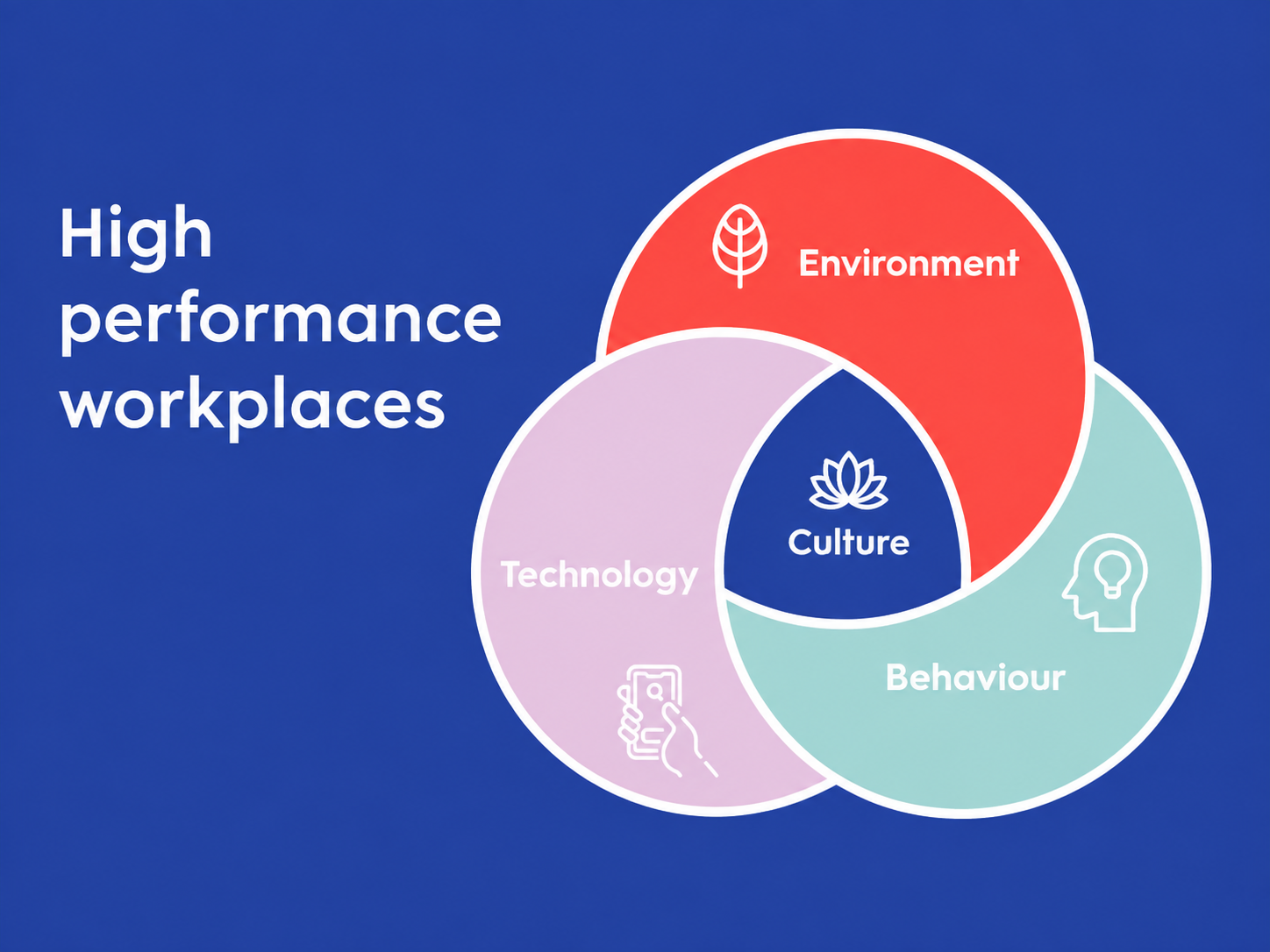
To help you get an understanding of your company’s culture, we’ve broken down what the culture of a high-performance workplace consists of:

High-performance workplace

We see company culture as an amalgamation of a few key things: Technology, Environment and Behaviour. These areas are interwoven, inextricably linked, and the building blocks of organisational culture.

Technology

Technology is a driver and enabler of culture. It provides the ability for seamless connections and also to make location agnostic. It fosters collaboration amongst teams and allows them to remain productive, whether in the office or remote. And while technology has been vital to the work from home shift during COVID-19, it’s just as important in the physical workplace. A bad technological experience, no matter the location, is remarkably detrimental to culture.

Environment

In a recent webinar Axiom hosted, we polled the audience, and most people said they plan to modify their existing physical office in response to the shift in working style we’ve seen over the past year. This is the perfect opportunity to think about how the physical environment can support and improve your company culture.

In our new hybrid working environment, it’s essential to consider how people are working in the co-located office. What tasks are being performed? How can the environment support those tasks specifically?

The other thing to consider is, now that people have the option to work from home, how can the physical office be designed in a way to attract staff back in?

To answer these questions, it’s essential to get to know your people by immersing yourself in your organisation. You need to understand your people, the type of work they do, and where and how they can do it best. In general, an office is a place of connection, learning, collaboration and socialisation, and designing the space to support these key elements will support strong company culture.

Behaviour

Behaviour is an obvious part of the company culture ‘pie’, which ideally should be underpinned by strong organisational values. The values held by employees on the inside will be reflected by their behaviour on the outside. However, creating company values, printing them on posters and sticking them on a wall is not good enough. Values must be role modelled from the top and built into the way business is done. Action must follow words, or company culture will suffer.

How has COVID-19 affected culture?

COVID-19 was a moment of truth for workplace culture in Australia. Businesses with robust, resilient and positive cultures are in much better positions than those with weak or negative cultures. In our last webinar, our panel noted that there had been a few common cultural themes highlighted over the pandemic. Let’s start with some positives.

For many employees, the move to remote work was an opportunity to get comfortable being more personal and open with colleagues. Work from home has been a window into people’s lives which wasn’t available before. Connections have become more genuine, and employees have felt they can be their whole selves.

Interestingly, given greater physical distancing, closer collaboration, and a willingness to jump in and help colleagues has also developed. This perhaps due to the “we’re all in this together” attitude that’s permeating companies.

The shared struggle has also seen an increase in empathy and understanding between colleagues, employees and employers. Before the pandemic, problems were usually individual and left at home. Now, everyone is weathering the storm, and the home is a genuine part of the workplace.

On the flip side, pandemic-induced isolation and job insecurity have unsurprisingly hurt employee wellbeing. Employees are struggling to switch off and set boundaries between work and home life.

Physical distancing, the rise in remote working and working in shifts also means less incidental, serendipitous meetings. These “water cooler” chats are often the catalyst for innovation, fresh ideas and collaboration, and we’re yet to see the true impact of missing out on them.

What is a cultural continuity plan?

Just like a business continuity plan, a cultural continuity plan is about making it through a crisis or navigating change and coming out the other side strong. It’s important that your business has the ability to translate what is important to the company (i.e. mission, vision and values) no matter what is happening externally or internally in order for your culture to be preserved.

Your cultural continuity plan starts with an outline of the things that are important to your company’s culture. Then it needs to address how these things will be protected when a crisis, like the pandemic, occurs. For example, if your business values social connections, and this usually looks like Friday night drinks at the pub, what will this look like in a lockdown situation?

How does the physical workplace affect culture?

As you now know, the environment is an integral part of the company culture ‘pie’. While it is only part of the equation, if you have a physical workspace, it is essential to building and supporting a thriving company culture.

However, we’ve found that most companies are not measuring how well their physical workspace supports their people, productivity and culture. Measurement is key to objectively interpret the progress of your company culture. Without proper measurement, you cannot see what’s being done well, what’s being done poorly, and where there are opportunities for improvement.

This is why Axiom developed the Workplace Thrive Index, a tool which will take the pulse of your organisation. Once the pulse has been taken with a carefully facilitated process, the Index score is measured against industry benchmarks and areas for improvement are determined. Want to know where your organisation sits on the Workplace Thrive Index?

Company culture is an essential part of the Future of Work, explore other considerations in the Future of Work: A Progressive Leaders Guide To Staying Ahead.

The office of the future: Transform your workplace for changing space requirements

The office of the future: Transform your workplace for changing space requirements

The pandemic has accelerated a range of pre-existing workspace trends around health and wellbeing, flexibility, activity-based working and the demand drive for better space utilisation. With this change in working habits, the requirements of COVID-19 workplace design have come into focus.

Things like high quality virtual connective hardware which were once on the “wish list” are now office must-haves. Some of these investments are now also within reach, thanks to boosted tenant incentives.

In this article, we’ll explore the new requirements of the office as well as the incentives on offer to fund these essential upgrades.

The new office must-haves

Right now conflicting forces are pulling at the future of office footprints. One is the need for more space to accommodate physical distancing protocols. The other is the need to reduce space with more people working remotely. In a post-vaccine world, physical distancing requirements will cease to exist, but the changes to the way people work are here to stay.

While technology has proven valuable to support and maintain collaboration and interaction in the required work from home period, long term it will complement but not replace the need for a physical workplace.

Long term, workspaces will have a rationalised physical footprint, and be comprised of flexible well-equipped spaces designed to support specific employee needs. The new office will have technology built in (eg. occupancy sensors or smart lighting solutions), a strong focus on health and wellbeing, plus a workplace design that is sympathetic to the productivity needs of employees while they’re in the workspace.

Entice employees to the workspace

Enhanced productivity, no commute and the opportunity to work in leisurewear – working from home has a lot of perks the office now needs to compete with. The new workplace needs to become a destination with a purpose which entices employees to return.

The office will need to offer more to employees than just a workstation to sit at for 8 hours a day. Rather, smart businesses will create places that attract and retain their employees with careful workspace design.

Employee health and safety

The new office puts employee health and safety front and centre. Workspaces will take advantage of technology and equipment such as hands-free or easy to clean materials (non-porous surfaces) and fixtures (automatic doors and taps) to rebuild employees’ trust and confidence.

Seamless connection between physical and virtual

Remote working isn’t going anywhere, which means the new office needs to be reconfigured to accommodate technology upgrades. Meeting rooms need to be equipped for seamless video conferencing, whether that’s with better quality screens and audio or faster data connections, to ensure flawless links between those out of and those in the office.

Collaboration and connection spaces

A key purpose of the new office is connection and collaboration between employees. With focussed and deep work done from home, employees will increasingly visit the office when human interaction is required, and the workspace needs to encourage and support this type of work. In a pre-vaccine world, these spaces will need to consider movable furniture for safe distancing and acoustic treatments which aid conversation across distance.

Use tenant incentives to create your new future-proof office

According to the Property Council of Australia, Australian office vacancy increased over the first six months of 2020 for the first time in four and a half years to 9.5%. This has created a pro-tenant market, and as landlords work to keep building values steady in a turbulent time, they are offering incentives to tenants like:

  • Rent-free periods
  • Rent abatement
  • Fitout contributions
  • Changes to rent review and make good terms

While tenant incentives aren’t new, they are currently on the increase. CBRE notes that in Sydney, “incentives are on the rise to encourage leasing activity in the market, nudging up around the 30% mark.” In previous years, this sat at 18-20%. It is a good time to take advantage of the increased incentives to fund your future-proof workspace upgrades.

Wondering what other future of work trends are affecting workspace design? Check out the Future Of Work: A Progressive Leader’s Guide.

The challenges of remote working, rationalising office space reductions, and maintaining company culture

The challenges of remote working, rationalising office space reductions, and maintaining company culture

As many businesses shift to a work from home strategy during the developing COVID 19 crisis, more Australians are working remotely than ever before. Rather than a passing trend, it appears the rise in remote working in Australia will permanently change our working culture. 

With benefits like supporting employee health, increased productivity, better work-life balance and the opportunity to cut costs by rationalising office space, it’s no wonder remote working is seen as the future of the workplace.  

But what do we know about the challenges of remote working in Australia and how to overcome them long term? And how will long-term remote work impact company culture? 

This post explores how an organisation might rationalise real estate costs, while still strengthening and maintaining its culture. 

Remote working benefits

Remote work had been on the rise for years before COVID 19 required people to shelter in place. Undeniably, the pandemic has accelerated the adoption of remote work across the world. And with this acceleration, companies have noticed some fantastic benefits for both employees and employers, not least of which is saving money on commercial real estate.  While there are some more benefits of this strategy, there are also some watch-outs too. 

Productivity and performance

Pre-COVID 19, a study found that 49% of professionals noted that they chose to work at home to complete deep, high-concentration work. So it’s not surprising that remote workers tend to be more productive. With more time and fewer distractions having a positive impact on productivity, remote work enables employees to focus on performance, results and higher quality work. Interestingly, this increased productivity and performance translate into greater employee engagement, which is significantly lowering absenteeism

However, not all types of work are easy to perform in isolation – in the Owl Labs Global State of Remote Work report, respondents said brainstorms are the most challenging meetings to follow and participate in when working remotely. Perhaps more surprisingly, a different study found that dull repetitive tasks are also more difficult for remote workers.

Rationalise commercial rent and other associated costs 

Remote working cuts costs for both employees and employers. According to Global Workplace Analytics, a part-time remote worker saves their company an average of $11,000 per year on rent and other associated office costs.  So adopting a work-from-home stance for the longer term can clearly help to rationalise space and lower rent costs for an organisation. 

However, a  physical workplace is more than an overhead cost of running a business. Culture, collaboration and connection between individuals and teams are essential to overall unity and directed output in an organisation. So the reduction of rent cannot be considered in isolation – any space reduction must be considered in terms of the longer-term impact on culture also. 

Healthier and happier employees

Aside from the obvious benefit of reducing the risk of spreading COVID 19, working remotely – even part-time, has been shown to increase happiness and lower stress for employees. Factors leading to improved employee wellness include:

  • More time for exercise
  • Healthy eating
  • Less exposure to illness
  • More time for interests and hobbies
  • Improved personal relationships

However, without the ability to leave ‘the office’ many employees are now working longer hours. A recent Bluejeans survey found employees are working an additional 3.13 hours per day from home. It’s therefore unsurprising that working at home can lead to the blurring of work and non-work boundaries which can lead to increased stress levels

Additionally, while remote work is well-received currently, due to COVID-19, Australians have only been working remotely for around five months (true at the time of writing). As the pandemic progresses and eventually passes, it is possible that extended remote work practices may become inhibiting and that a stronger delineation between work and home is desired. 

Attracting and retaining talent

In a Zapier remote work report, about 75% of workers said they would be willing to quit a job that didn’t allow remote working for one that did. Unsurprising then that top HR executives recognise that offering remote working and flexibility will help a company to attract top talent and source the best candidates, regardless of location. 

Having said that,  some office-based collaboration and connection is still largely desired, and intelligent workplace strategy and design – even in a smaller corporate space, will assist in meeting those collaborative goals. 

Why you might consider rationalising – not leaving – your commercial office space 

Many organisations are now rationalising their commercial spaces, looking for some kind of hybrid solution that ensures culture and connection can be maintained, while remote work can support wellbeing, productivity and balance.  

Collaboration and communication

Water cooler conversations, lunch with a colleague, team chats over coffee, all of these co-located office scenarios allow passive information gathering, which is lacking for remote workers. While a Slack chat is helpful, it doesn’t have the same impact as an in-person interaction. In fact, a study found that a face-to-face request is 34 times more successful than an email. 

The bottom line is that there are fewer opportunities to communicate effectively when working remotely full time.

Smart workplace design with clever sensing technologies can instead help organisations to optimise their commercial space, in order to utilise space in a planned, efficient manner, maintaining social distance while reaping the benefits of commercial collaboration when in the office too. 

Building company culture

Humans are social creatures who have a biological requirement for connection with others. Being physically near colleagues provides us access to a broad range of subconscious information and non-verbal communication cues. Remote working full time and only connecting virtually cheats us of these opportunities – the impact of which will be realised over time.  

Take the opportunity to come together in person when it is safe to do so. Physical distancing solutions can be achieved with clever design and smart technology that manages room and desk availability in a user-friendly manner.  There are clever ways you can make employees feel (and be) safe in the office environment. Not only does this kind of investment rationalise rent now and help keep employees safe, but it ensures the efficient use of all office space into the future, further saving on commercial rent and making the best of the space you have. 

Employee wellbeing

While remote working is often seen as a bastion of employee wellbeing, it can lead to feelings of isolation and stress for some. It’s easy for boundaries to become blurred when employees aren’t leaving ‘the office’ at the end of the day. Without this clear distinction, unhealthy habits can form, like working back late and less in-person connection (whether that is with coworkers or family at home). 

A hybrid remote work and in-office solution can help to maintain such balance. In the office employees’ work and personal time boundaries are so much more defined. Similarly, supporting remote workers to find their ‘third place’ whether that be a 5 pm walk or a group call prior to logging off for the day can assist. Recent experiences also show that an ergonomic home office that is separated from casual living space also helps to delineate work and home life.  

Interruptions and distractions

While remote workers don’t need to worry about common office interruptions, they do have a whole host of new distractions at home. Whether it’s unannounced visitors, children arriving home from school, a spouse who types too loudly, or a delivery driver at the door, it can be challenging to maintain focus in non-commercial environments. 

Whether in the commercial office or not, there isn’t a way to avoid all interruptions, but there are some strategies that can assist. 

  • Set office hours – you’re not to be disturbed between the hours of X and Y
  • Noise-cancelling headphones (and tell others what it means when you’re wearing them)
  • A home office with a door and a  ‘do not disturb’ sign when you need to keep your head down
  • An option to attend a safe, well-designed commercial office where you can work quietly and comfortably with less distractions should home become challenging 

While remote work is likely to be a component of workplace strategy for some time, many Australian organisations are considering the longer term implications of this on culture and collaboration. Many conversations in the market are currently pitted around rationalising real estate costs by reducing and optimising commercial space. This then enables individuals and teams to work remotely some of the time, and use the office at other times – which is an extension of the activity-based trend we’ve been seeing for the last few years. 

To manage this successfully and for the long-term, you may wish to consider aspects of design that assist with social distancing, that help to optimise and utilise underused space, and assist employees to find and use workspaces with efficiency and ease.

If you are looking to optimise your workplace for staff productivity and wellbeing, our proven workplace strategy and design process thoroughly considers your current realities, business objectives and future plans – including remote working. Find out more about our process here. 

Managing remote teams: how to support your employees while working from home

Managing remote teams: how to support your employees while working from home

Remote work is no longer a temporary fix, it is how modern businesses operate. Today, over 6.7 million Australians, roughly 46% of the employed population, work from home at least some of the time, according toRoy Morgan's 2024–2025 research. For managers and business leaders, this means that managing remote employees effectively is no longer optional. It is a core leadership skill.

Leading a fully distributed or hybrid workforce comes with the same challenge, keeping employees engaged, productive, and supported without regular face-to-face interaction.

Why Managing Remote Employees Matters More Than Ever?

The numbers tell a clear story. According to theAustralian HR Institute, 97% of Australian organisations now offer some form of flexible remote working. A McCrindle survey found that 78% of Australian employees prefer a hybrid model, andPwC research confirms that the average Australian professional wants to work from home at least 3.2 days per week.

At the same time, managing staff working from home brings real challenges. Without face-to-face contact, miscommunication increases, team culture weakens, and employees can feel disconnected from the organisation. Gallup's latest workplace research confirms that management quality is the single biggest driver of remote team performance, and the bar for managers is even higher in a distributed setting.

This is why having a structured, intentional approach to managing a remote team is not just helpful, it is essential for any business that wants to retain top talent and stay competitive.

1. Emotional Wellbeing: Keep Your Remote Staff Connected and Supported

One of the most common struggles faced by remote employees is a sense of isolation. Studies show that75% of fully remote workers experience some form of stress, anxiety, or burnout at some point. When managing remote staff, emotional health should be a top priority, not an afterthought.

Here is how to support your team's emotional well-being effectively:

Communicate clearly and consistently. Remote teams with strong communication habits are 25–30% more productive and engaged than those without. Hold regular one-on-one check-ins and weekly team huddles so your remote employees always know what is expected and where they stand. Clear expectations remove ambiguity and reduce workplace anxiety.

Build genuine social connections. Virtual lunches, informal chat channels, and online team-building activities help remote employees feel part of something bigger. When working with remote teams, social touchpoints matter just as much as task-related updates. Do not underestimate the value of casual conversation in keeping team culture alive.

Support mental health proactively. Provide access to Employee Assistance Programs (EAPs), mental health apps likeHeadspace orCalm, and telehealth services. Normalising conversations about mental health builds psychological safety across your team. According toNulab's 2025 guide on managing remote employees, telehealth services and EAPs are among the most effective tools for reducing remote worker burnout.

Recognise effort and achievement. Remote employees often feel invisible compared to office-based colleagues. Build recognition into your management rhythm, whether it is a shout-out in a team meeting or a personalised message acknowledging quality work. Consistent recognition improves morale, loyalty, and performance.

Promote healthy work-life boundaries. Remote workers are statistically more likely to overwork than office-based employees. Reinforce the importance of finishing at a set time, taking real breaks, and fully disconnecting after hours. This protects long-term performance and prevents burnout.

2. Effective Technology: Give Your Remote Team the Tools They Need

Technology is the backbone of managing a remote team in 2026. Without the right platforms, collaboration breaks down and productivity suffers. The good news is that the tools available today are better, smarter, and more integrated than ever before.

Here are the core categories every remote team needs to be covered:

Communication platforms. Tools likeMicrosoft Teams,Slack, andZoom form the foundation of day-to-day collaboration. Usage of these platforms has grown by over 60% since hybrid work became standard across Australian businesses, and they remain essential for keeping remote employees connected in real time.

Project management tools. Applications likeAsana,Trello, orMonday.com help teams stay aligned on tasks, deadlines, and priorities without the need for constant check-in calls. They also give managers clear visibility into progress without micromanaging.

Document collaboration platforms. A centralised hub likeGoogle Workspace orMicrosoft 365 ensures everyone works from the same source of truth, eliminating version confusion, missed updates, and long email threads.

Asynchronous communication tools. Not every update needs a live meeting. Tools likeLoom for recorded video messages andNotion orConfluence for documentation allow remote staff to stay informed and contribute without needing to be online at the same time. This is especially valuable for teams spread across different time zones or working flexible hours.

AI-powered productivity tools. In 2026, more organisations are integrating AI assistants into their remote workflows, from automated meeting summaries to smart task prioritisation. These tools reduce administrative load and help managers focus on people, not processes. Explore howAI is reshaping the modern workplace and what it means for distributed teams.

When building a tech stack for managing remote staff, simplicity matters. Too many overlapping tools create confusion and fatigue. Aim for a lean, integrated set of platforms that covers communication, collaboration, and documentation clearly.

3. Physical Wellbeing: Set Up Your Remote Employees for Long-Term Health

Physical setup is often the most overlooked area when managing staff working from home, yet it has a direct impact on health, comfort, and daily output. Many employees are still working from dining tables, unsupported chairs, or poorly lit rooms, and this takes a measurable toll over time.

Research from ergonomics experts shows that a properly set-up home office can deliver a25% uplift in productivity and significantly reduce injury risk and compensation claims. Investing in your employees' physical workspace is not just a well-being gesture, it is a smart operational decision.

Here is what strong physical support looks like in practice:

  • Offer a home office equipment allowance so employees can purchase a proper desk, chair, and monitor setup.
  • Provide ergonomic checklists or a short self-assessment guide to help staff configure their space correctly.
  • Encourage regular movement breaks, stretching, and screen-free periods throughout the working day.
  • Consider subsidising standing desk converters or ergonomic accessories for employees who flag discomfort.

For organisations that want a more structured approach, working with aworkplace design and strategy specialist can help you build a comprehensive work-from-home support program that covers ergonomics, equipment standards, and employee wellness in one framework.

4. Building a Remote Work Culture That Actually Sticks

Beyond the three pillars, the most successful remote teams share one thing in common: a strong, deliberate culture. When people are not sharing a physical office, culture does not happen naturally, it has to be built with intention.

Lead with outcomes, not hours. The most effective approach to managing remote employees is a results-oriented mindset. Assess performance based on what people deliver, not when they are logged on. This approach, championed by leading remote-first companies like GitLab and Atlassian, builds trust, reduces micromanagement, and gives staff the autonomy they need to perform at their best.

Invest in your managers.Gallup's research makes this clear: the quality of management is the biggest differentiator in remote team performance. Train your people leaders in virtual communication, giving feedback across distance, performance coaching, and building trust without in-person interaction.

Document processes and decisions. Successful remote teams operate on a foundation of clear documentation. When project briefs, team decisions, and process guides are written down and accessible to everyone, working with remote teams becomes smoother, faster, and less dependent on back-and-forth messages or unnecessary meetings.

Stay consistent with structure. Remote work performs best when there is a clear weekly rhythm, regular stand-ups, team check-ins, and asynchronous update cycles. This keeps remote employees anchored and aligned, while still giving them the flexibility that makes remote work worth it.

Common Challenges When Managing Remote Staff and How to Overcome Them

Even the best remote teams still face problems from time to time. Understanding these issues early helps you fix them before they grow into bigger problems.

Communication gaps. Without in-person cues, messages are more easily misread. Encourage clarity in written communication, and confirm understanding after key decisions. Build a culture where asking questions is always welcomed.

Burnout and always-on pressure. Remote employees often find it harder to switch off. Reinforce healthy boundaries as part of your team culture, not just policy. If someone is consistently working late, address it directly rather than rewarding it.

Isolation and disconnection. Even independent workers need social contact. If a team member goes quiet for several days, check in personally. Regular human connection, not just work updates, is what keeps remote staff feeling like they belong.

Visibility and career growth. Employees who are physically absent from the office can feel overlooked for development opportunities. Make career conversations, mentoring, and project visibility a deliberate part of how you manage your remote team, not something that only happens in the office.

Empowering Remote Teams with Smarter Workplace Support

At Axiom Workplaces, we know that great work happens when people have the right environment to support them, whether that is in the office, at home, or somewhere in between. Ourworkplace strategy team works with Australian organisations to design spaces and structures that bring out the best in their people, regardless of where they work.

If you are ready to build a stronger approach to supporting your remote employees, explore ourworkplace guides and work-from-home resources orbook a consultation with one of our experts today.

The importance of an ergonomic home office

The importance of an ergonomic home office

In recent years, flexible work arrangements have been increasingly sought by the Australian workforce. However, it hasn’t been until the current COVID-19 crisis that many organisations have stumbled upon the overriding benefits of working from home. As a result, and also because people will not soon forget the potentially dangerous impact of personal contact, futurists are predicting that when quarantine ends, remote working will continue for many.

How to set up a home office 

Setting up an ergonomic home working environment is harder than it sounds. While stock imagery frequently features bespectacled models in grey wool, curling up on a trendy sofa with their laptop, the reality for many is far from that. Most of us make do with a makeshift desk, a static chair at the dining table, or perching on a stool at the kitchen bench.

However, if your company is serious about productivity, improving your team’s ergonomic set-up at home should be your top priority. Research completed by the Washington State Department of Labor and Industries in the US recently found that ergonomics is well worth the investment.

The study showed that ergonomics significantly reduces company costs, with a 65 percent reduction in incidence rates and a 75 percent reduction in lost workdays. Additionally, ergonomics can improve employee productivity by up to 25 percent, as well as the quality of work, with a 67 percent average reduction in errors.

Of course, ergonomic workspaces increase employee engagement as staff recognise and appreciate the investment in their safety and comfort—and the numbers in the study support this too.

What exactly is an ergonomic workspace? 

An ergonomic workspace is one that is comfortable enough to improve both wellness and productivity. It can involve the proper arrangement or modification of existing furniture and equipment, or the purchase and installation of supportive items that are designed to align and support the body during work periods.

It usually includes items such as your office chair, key objects like the phone, print equipment and materials, keyboard and mouse, screen, footrest and desk, as well as light and your monitor. It can also extend to items that support helpful behaviours, such as office storage that prevent mess and distractions in your workspace.

Why consider investing in ergonomics at home? 

If remote working is to continue in some form over the coming months and perhaps years, and an ergonomic set-up can provide anywhere up to a 25 percent uplift in productivity, it seems like an obvious choice to invest in some best-practice home office set-ups. Just as commercial office design equips people for work and engagement, so too can remote workspaces.

Building a productive, ergonomic workspace at home

On an individual level, it could be relatively easy to read a guide and set yourself up for success. However, when managed from an organisational perspective, a little forethought, research and expert help can make all the difference.

1. Evaluation 

The first place to start is in evaluating the employee’s set-up. Is there a known issue with their workspace that can be fixed with rearranging furniture, buying ergonomic equipment or fixing lighting? If evaluating more than 20 employees in this way, you’ll need a well-designed survey so you can assess patterns and create a strategy that combats the majority of high-impact issues. Individual issues can be addressed thereafter.

2. Results and recommendations 

Results of your evaluation can mean purchasing equipment, or simply making some small changes to where and how people are currently set up.  A good ergonomic chair is a strong starting point that helps keep the body aligned and allow for some movement. There are many ergonomic options out there on the market, so choose an expert to work with for the best value, best practice options.

Remember – desk and chair position, body position, movement breaks and other behavioural aspects can have a huge impact in instances where you cannot afford to purchase equipment for every, single employee, so don’t discount training.

3. Employee training 

With every investment in a productive workspace comes a corresponding commitment to best practice behaviours from the company, as well as the individual.  Training on the seemingly smallest aspects of behaviour and office set-up can significantly reduce strains and injuries. For example, natural light decreases fatigue and improves feelings of wellbeing and happiness. Keeping a screen perpendicular to a window can reduce glare and therefore eye strain, while providing the required illumination for computer and desk work.

Employee training can deliver many specialist directives that are easy to implement but have a huge impact on wellbeing and output.

What to do next 

While the government is starting to talk about restrictions being lifted, many bodies predict that social distancing measures could continue as long as into 2022. As remote working is also more cost-beneficial to many organisations, this could mean that widespread remote working will continue long after social distancing measures are relaxed.

It may be worth modelling what this looks like for your business in the coming months and years. If remote working even for part of your workforce continues to make sense, you’re going to need to invest in the right equipment and advice for your people.

If setting up ergonomic home offices for your employees is something you’re not sure about, get an expert involved early in your planning and get your business ahead of the competitive curve.

Axiom Workplaces applies principles of ergonomic office design to remote working. We help organisations achieve maximum wellness, engagement and productivity for remote teams around the future of work.

What does the future of workplace look like for employees and employers?

What does the future of workplace look like for employees and employers?

The workplace is changing around us as we speak. With more and more people working remotely or with flexible work arrangements, employers are facing new challenges daily in how they create a positive company culture, enable collaboration, attract new talent and plan for growth.

Because of this, there is a serious conversation happening all over the globe about what the future of work and its workforce will look like. We’re in the middle of a massive overhaul of the workplace as we once knew it. The questions we are constantly being asked, and asking of ourselves, is how we can better shape workplaces to accommodate these shifts, while also future-proofing and facilitating these new ways of working.

With this is mind, we invited Cindy Lenferna De La Motte, Future of Work Strategist and Head of Customer and Community at Harvest Digital Planning, to join Annelie Xenofontos, Axiom’s Senior Workplace Strategist, to lead a conversation on company culture, how to create intelligent workplace design outcomes and the future of the workplace. The answers below are a summary of both their responses during the event.

What are the key challenges of the future workplace?

It’s here, it’s arrived and we are already working in this ‘future’ workplace. The key challenge here is the pace of the evolution, and how businesses and employees are keeping up.

Professional development, once considered a 'nice-to-have,' has now become a critical 'must-have' in the evolving future of work. Future of work strategists emphasize that individuals should dedicate three hours per week to enhancing their skills, ensuring they stay relevant and adaptable in the workplace over the next 25 years. By prioritizing continuous learning, professionals can future-proof their careers and remain competitive in an ever-changing job market.

Upskilling and innovation play a massive role; businesses alone cannot afford or accommodate the pace of upskilling that individuals need to keep up with the digital evolution that’s happening. Employees need to take on this growth mindset and responsibility for themselves, and employers need to wholeheartedly support and facilitate their learning.

Those in senior roles, leading business change and growth, cannot rest on their tried and tested measures. Instead, they must lead the way in updating their knowledge and learning so as to drive innovation both in their businesses and in their staff, ensuring their business remains competitive and up-to-date.

There are numerous meet-ups, short courses, podcasts, reading material and forums to meet up with other people, learn and share information. Gone are the days of doing a university degree that will see you through a job for life and into retirement. The lifetime of learning in degrees is now estimated to be three to five years post-graduation, so adopting a new approach and mindset to lifelong learning, even into retirement, is part of the future of work evolution.

From a workplace perspective, customisation is now a baseline requirement. We don’t want to fit in a box anymore. We are working in more sophisticated ways, and we want and expect a customised work environment that supports innovation, creativity and efficiency.

Businesses need to constantly think about what is next and their workplaces need to be conducive to thriving in this evolution.

What are the top skills needed for the future workplace?

Diversity and inclusion are topics that have been talked about for a while and are certainly on the HR agenda, but they need to be highly prioritised in the workplaces of the future. Workspaces need to be designed to facilitate the collaboration of employees of different ages, cultures and backgrounds, and to enable spontaneous conversations, innovation and learning to occur. The evolution of business practices doesn’t only come from business leaders anymore. It comes from every person in the workforce.

Young people coming into the workforce have a wealth of information to bring, while the current working generations have significant experience to draw on. Encouraging collaboration between generations through smart workplace design and technology allows a business and its staff to bolster and flex its knowledge base for now and into the future. This is where the magic of a diverse workforce happens.

In Australia, we are relatively good when it comes to creating a diverse workforce, particularly in larger cities, however inclusion of a diverse workforce still requires attention. We need to be choosing skills and capabilities over age, location and culture to keep our businesses at the forefront, and upskilling current team members into new roles to keep them relevant.

Is the war for talent real?

We have a skills shortage in Australia and the war for talent is real and fierce. According to the Australian HR Institute, there are almost one million more job opportunities than there are employed people in Australia.

The top companies are offering impressive compensation and benefit packages, which the most talented individuals are honing in on. And businesses are getting clever with what they are offering—thinking not just about more dollars, but also about the ways their staff want to work and live.

Your culture, mission, purpose and workspace have such an impact on your employer value proposition (EVP). From the moment someone walks into your office space, they think about whether it feels like a good company to work for. Is your office representative of your culture and attractive to talent?

A workplace that embodies the culture, mission and purpose of the company lives out its values and starts to hand back autonomy to staff, one of the biggest motivators for top talent. Invest in your employees through creating a space that’s meaningful to them and allows them to do their best work. Creating a comfortable work environment and reducing employee frustration are key metrics in your workspace design, as are:

  • Green spaces
  • Personalised spaces
  • Quiet spaces
  • Environmentally friendly processes
  • A focus on health and wellbeing
  • The opportunity for connection, creativity and deep work

Cindy says, “At Harvest Digital & Planning, we made a conscious decision to source the best candidates for skill and capability regardless of location. The world is literally our oyster and right now our team is 100 percent remote.”

Remote working comes with new challenges, but ones that we are working through, finding new ways to be inclusive and find the emotion in our day-to-day interactions as face-to-face teams do. With remote and flexible working becoming the norm, businesses and workplaces need to find new ways that work for them and their own cultures to address inclusion for remote teams. We don’t have all the answers but we are experimenting together.

What kind of technology and processes can you use to bring remote workers and workspaces together?

This will differ from organisation to organisation depending on your workplace culture and the type of work that you do. But at the heart of it is asking yourself what your team needs in order to stay connected at a human level, as well as at an operational level.

Some businesses initiatives that have worked for businesses we know are:

  • Ensuring that all new employee onboarding is done face-to-face, even if that means flying someone to head office for an induction. Ensure that all managers of new staff make the time to make that face-to-face connection as this is the start of inclusion and sets the tone from the outset of the employment relationship.
  • Connecting people back in through regular town halls or team-based meetings.
  • Communication is critical so have a real-time tool like Slack or Skype for chat. This also helps reinforce culture.
  • The “cupcake experience”: always consider who isn’t in the office to receive the cupcakes brought in by a team member. What can you do for those not getting a cupcake? It might seem like a small thing, but it goes miles when it comes to making a remote worker feel included.
  • Pizza hour: bringing everyone together to eat pizza.
  • Using emojis or gifs in communication allows emotion and sentiment to come through in email and internal comms.

Workplaces can evolve and flourish in businesses with lots of remote workers with some innovative thinking.

At Axiom, we encourage businesses we work with to think about how they might be innovative with their space depending on the outcomes they require. How much space do they really need? How can they reduce their environmental footprint, waste and cost by thinking about the way their staff will use the workspace?

Solutions such as agile working environments that chop and change according to business fluidity, spaces for technology that connect staff members both in-house and remotely, flexible working so spaces might be used differently on different days depending on who is in the office and the outcome they want to achieve, and even lending out space that is not used all the time—not only can it spark creative partnerships and collaborations but it’s also commercially viable.

Where do I start to futureproof my workplace?

Teaching new ways of work requires teaching individuals a growth mindset. For organisations and business owners, start with a small experiment or collaborate with a new partner to challenge your current ways of working.

Ask yourself, am I still doing the right thing? How could I reimagine my workforce connecting, thinking and innovating? Try something different that aligns with your business. Listen and engage your people and implement.

What are the top 3 things that a modern office should have for a thriving environment?

It’s a feeling thing! Each business has a different identity so it’s not a one size fits all approach. You have to tap in and consider what space and technology you need to create the feeling that you want your employees to have when they step into the office. You want staff to love going to work because it feels good.

Although we’re living through a period of rapid change and unprecedented uncertainty, there are still things businesses can do to future-proof their workplaces. Find out more about the future workforce in the Future of Work: A Progressive Leaders Guide To Staying Ahead