Posts by Axiom Workplaces:

Commercial lease advice: the 6 lease clauses it pays to include in Australia

While new business models, fresh ways of working, and an increasingly tech-enabled ecosystem have shifted the workplace needs of companies(see trend coverage in CBRE Insights & Research and JLL Insights), one thing remains crucial throughout the disruption: the commercial office lease. Global CRE conditions have evolved across investment, office and logistics, with leasing momentum and capital flows improving into 2025 per JLL’s latest global outlook (JLL Global Real Estate Perspective). For current market intelligence and landlord/tenant dynamics, see CBRE Insights & Research.

A commercial lease is a binding agreement between landlord and tenant which sets out both parties’ obligations. The lease spells out terms and clauses for both landlord and tenant, so you, as the tenant, can better understand exactly what you’re entering into. Seeking out advice from trusted partners throughout your entire lease expiry process is smart, but when it comes to commercial office lease, advice from a tenant representative or legal advisor can help to ensure your lease agreement is favourable and fair.

What’s in a commercial lease agreement?

All commercial leases include what is known as ‘essential terms‘. As the name suggests, these terms are essential to the contract and without them, it may not exist at all. Essential terms are things like payment of rent, names of the parties involved and a description of the premises to be leased.

Outside of the essential terms, there are a number of clauses that can be included when it comes to your office lease. In this post, we will unpack six commercial lease clauses you can’t afford to NOT know about.

1. Subletting

The option to sublease part of your property to a third party can be helpful if your company’s space requirements are likely to change over the course of your lease. For example, if your business is downsizing, subletting some of your space can support cash flow by making use of unused floor space.

The option to sublease will need to be written into your lease agreement from the outset. Know that your original lease remains in effect even when a new sublease has been signed.

2. Repairs and maintenance

Maintenance and repair obligations should both be set out in your commercial lease. Generally, as a tenant, you are responsible for the ‘rented premises’ like floors, walls and fixtures, and are therefore required to repair and maintain them during your lease.

On the landlord side, maintenance and repairs to the structural parts of the premises, building systems and common areas like lobbies or the lifts are usually included. Check your lease carefully though as sometimes these items can be inserted under the tenant’s obligations.

3. Ending the lease early

Including a ‘break clause’ allows you to terminate the commercial lease earlier than the specified term. Most break lease clauses include a notice period where you must let your landlord know of your intention to break the lease.

If your lease agreement doesn’t include a break lease clause, and you end up needing to leave your lease earlier than the anticipated term, you may be required to buy out the term of your lease, assign it to a third party or otherwise negotiate an early exit with your landlord.

4. ‘Make good’ clause

A ‘make good’ clause is a standard inclusion in many commercial leases. The make good provision is negotiable but basically requires the tenant to return the premises back to their original condition, regardless of any improvements that have been made during the lease period.

Before you sign on the dotted line, ensure the make good clause is clear for both parties and you understand your obligations at the end of your lease. You’ll need to consider this additional cost when you decide whether to move at the end of your lease Given rising re‑fit costs and reduced new‑start pipelines in many markets, make‑good budgeting warrants stress‑testing; cross‑check current cost trends and fit‑out benchmarks in JLL Insights.

Furthermore, complete a thorough condition report including photos and videos of the office at the start of your lease. This will help you to avoid nasty surprises at the end of your lease agreement by providing clear evidence of the original condition of the premises.

5. Rent review

The ‘rent review clause’ explains the process for increasing the rent as the term of the lease proceeds and is common in many commercial leases. The common methods of rent review include:

  • ‘Fixed percentage increase review’ that specifies a fixed rent increase on designated dates during the lease term.
  • CPI rent review which is directly correlated to movements in the CPI (Consumer Price Index).
  • Market rent review that reassess your rent in relation to the state of the financial market.

Ensure you are aware of the type of rent review clause your lease includes and that it suits your business requirements. When negotiating CPI, fixed, or market reviews, anchor your positions to current cycle dynamics and transaction evidence. Macro and sector context is summarized in JLL Global Real Estate Perspective and CBRE’s market reports within CBRE Insights & Research.

6. Option clause

An ‘option clause’ gives the tenant the option to renew their lease at the end of the initial lease term. Usually, the option needs to be exercised within a certain time period (eg. six months before lease expiry), and the tenant must not have breached any terms in the contract during the lease period. An option clause isn’t mandatory, so check your lease before signing. Option value is highly market‑dependent; vacancy, pre‑leasing, and construction pipelines influence leverage, see current market snapshots and pipelines in Colliers Research.

As you can see, a commercial lease is complex and, as a legally binding document, you want to ensure you’ve got all the bases covered. But the lease terms are just one part of the lease expiry process. To negotiate the right terms for your needs, you need to consider every aspect of the process and develop a robust workplace strategy. For more commercial lease advice and to learn more about choosing the right workplace design partner for your strategy, download our free ebook today.

Understanding Commercial Lease Terms That Matter

The Importance of a Solid Commercial Lease Agreement

A commercial lease agreement outlines the terms and conditions between a landlord and a business tenant. These commercial lease agreements aren’t just formalities they define how your workplace operates and what you're responsible for. Whether you’re entering a commercial business lease agreement for the first time or reviewing an existing one, it’s essential to understand each section fully.

Working with a consultant or legal advisor can help you evaluate commercial lease agreement terms, identify risks, and ensure the lease works in your favour. It’s one of the smartest investments you can make as a business tenant.

Make Good Clauses and End-of-Lease Conditions

One of the most commonly misunderstood terms in a commercial tenant lease agreement is the make good clause. This clause outlines how the tenant must return the property at the end of lease and it can include significant costs. A clear understanding of both commercial make good obligations and end-of-lease make good expectations is vital before signing any agreement.  For context on market cost pressures, review fit‑out and cost trends within JLL Insights.

A thorough condition report with photos and documentation at the beginning of your lease is a good way to protect your business from future disputes. If you're unclear about what's included in your commercial end of lease obligations, seek advice early in the process.

Reviewing and Negotiating Commercial Lease Terms

Lease terms should never be taken at face value. Whether you're signing a new lease or going through a lease review, take time to examine clauses around maintenance, break options, subletting, and rent increases. Many commercial property lease terms can be negotiated to suit your business goals.

Standard clauses like the break clause commercial lease, commercial lease maintenance clause, or option to renew often have strict notice periods or conditions attached. Know your deadlines and understand how each clause affects your ability to expand, exit, or adapt your space.

Crafting the Right Commercial Lease for Your Business


Every lease agreement business and commercial tenant signs should support long-term strategy. The best commercial lease clauses reflect your company’s priorities whether that’s flexibility, growth, or stability. Customisation of commercial lease terms and conditions ensures your workplace setup aligns with both legal requirements and operational needs.

Even the most standard commercial lease terms can include specific wording that shifts responsibilities, costs, and control. Clarifying your rights and obligations before committing helps avoid unnecessary surprises later on.

Conclusion: Your Lease Shapes Your Workplace Strategy

A commercial lease is more than just paperwork; it's the foundation of your business location. From subletting to rent reviews and making good obligations, understanding your commercial property lease advice is essential.

By taking the time to review your lease agreement commercial in detail, and getting expert guidance when needed, you put your business in the strongest position. For tailored advice on leasing, workplace planning, and office design, reach out to Axiom Workplaces.

Conclusion

A commercial lease is more than just paperwork; it's the foundation of your business location. From subletting to rent reviews and making good obligations, understanding your commercial property lease advice is essential.

By taking the time to review your lease agreement commercial in detail, and getting expert guidance when needed, you put your business in the strongest position. The better you understand your lease terms, the more control you have over your future space.

Further reading and current market references

Why Choose Axiom Workplaces?

At Axiom Workplaces, we do more than design offices. We support your business at every step of your leasing journey. Whether you’re negotiating a new commercial lease, reviewing your current agreement, or preparing for the end of lease, we’ll help you make smart, informed decisions.

Our team combines leasing insight with workplace design expertise to create spaces that support how your people work now and how they’ll work in the future. We’ll guide you through the process, from lease clauses to layout, ensuring your new space works for your people, your budget, and your business goals.

With Axiom, you don’t just get a fitout, you get a partner who understands the big picture.

Frequently Asked Questions (FAQs)


How to choose a workplace design partner ebook

Axiom Workplaces combine your commercial fitout goals with our experience and expertise in evidence-based office design to create a thriving workplace for you and your workforce.
Design File: ELMO

Design File: ELMO


“ELMO HQ has realised more connectivity and community engagement than I had ever hoped for.”
Monica Watt, General Manager HR and Admin, ELMO

As one of the fastest-growing HR tech companies in the region, providing innovative cloud HR and payroll technology to more than 1000 organisations across Asia-Pacific, ELMO were quickly outgrowing their space. As well as moving to a more centralised location in the Sydney CBD, ELMO wanted a fit-for-purpose space that would re-energise their employees (or “ELMOnians”, as they’re affectionately called), and help keep the company on its path to growth.

Before Axiom…

Having experienced exponential growth over the past few years, ELMO were fast outgrowing their original headquarters in Bondi Junction. But ELMO didn’t simply want a bigger space – they wanted a space that would truly reflect their personality, culture and values. They wanted a space that would foster connection and collaboration, increase engagement, and also be highly adaptive to each ELMOnian’s preferred way of working.

There was also the added challenge of a relatively short lead time – with ELMO growing so quickly, they only had a timeframe of 12 weeks in which to bring their vision to reality.

Axiom worked closely with ELMO, conducting in-depth workflow and organisational studies to fully understand ELMO’s needs and help them achieve their objectives.

“The Axiom team was great to work with from the commencement,” says Monica Watt, General Manager HR and Admin of ELMO. “They were engaging and responsive to our needs … [and] honest about what they had and had not done. Once they captured our thoughts and concepts … we then worked together to continuously evolve the design. The space is a combination of our ideas and their design magic coming together.”

After Axiom…

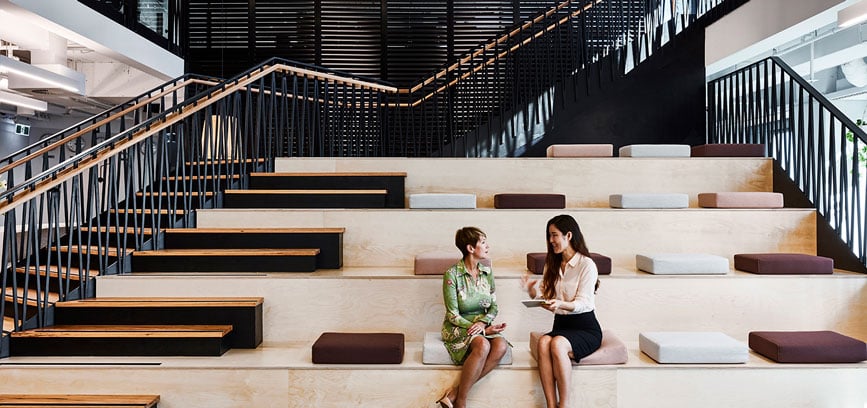
One of the most important traits ELMO wanted to cultivate in their new space was connectedness and collaboration. With this in mind, the Axiom team designed a central town hall at the very heart of ELMO’s new home, with tiered seating where employees can gather. This space is connected to a breakout zone on another floor by a staircase, further emphasising the idea of connectedness.

Annelie Xenofontos, Axiom’s Senior Workplace Strategist, explains the team’s approach: “We wanted to connect the Elmonians by creating a vertical village through the two floors. The continuous louvred finish across the two floors achieved that visual connection and was accentuated with the larger cutout in the concrete slab.”

Employee wellbeing was also highly important to ELMO, with the attraction and retention of top talent being a key objective of the new office. To that end, the design included a café and community space where staff can relax and socialise, and a wellness room where they can practise yoga and meditation. As per ELMO’s request, the meeting rooms were also placed at the core of the design, to ensure that employees could be seated close to natural light.

“I love that every day from morning through to afternoon, I see our people enjoying a cuppa, working, talking, and sharing the space. There is a spot for everyone and everything,” says Watt.

To reflect ELMO’s growth and maturation, a new colour scheme was devised, keeping true to the company’s history and evolution while showing the company’s progressiveness and innovation. The use of green and greenery throughout makes the space feel calm and inviting.

Axiom also future-proofed the new HQ, ensuring it is flexible enough to incorporate more employees as the company continues to go from strength to strength.

“The greatest success was hearing the oohs and ahs from our people. I will be honest, I was overwhelmed with various emotions on day one – I sat on the tiered seats and just watched the people enjoying their new space,” says Watt. “I am in awe of what we have created and the opportunity it presents.”

At a glance…

  • Increased connectedness and collaboration achieved
  • Emphasis on employee wellbeing
  • Flexibility to adapt to continuing growth
  • Design successfully developed and implemented in just 12 weeks

Ready for Axiom to work some design magic on your current or new office space? Book a free consultation to see what we can do for you.


5 ways technology can support business innovation

5 ways technology can support business innovation

Few would argue with the notion that technological innovation in business is the lifeblood of successful and competitive companies today. If you’re a company stuck in the grind of ‘business as usual’, business technology innovation may hold the key to unlocking your employees’ hidden potential for creativity and growth. (And it doesn’t have to break the bank either.)

Here are 5 ways technology can support innovation in the workplace.

Improved communication and collaboration

There’s a reason why so many companies are trying to break down silos within the business and foster more collaboration – improved communication frees the flow of ideas, allowing for better insights and faster decision-making. Deloitte has even put a dollar amount on the benefits of collaboration, estimating that quality improvements brought about by collaboration are worth around $2517 per employee and manager per year.

Collaborative platforms like Google Docs or Slack allow people to share files, collate discussions around particular topics, centralise knowledge and work on documents simultaneously. This means you can get on with the business of working together without any of the frictions and frustrations that often go with it (‘Where did that email end up?’, ‘Why haven’t they got that document back to me yet?’ etc.).

Video and voice conferencing technology, such as Zoom, can help to tear down communication barriers, which is particularly helpful if your team is spread out geographically. Interactive whiteboard technology like Webex or Jamboard also gives your team the freedom of brainstorming on a whiteboard combined with the ability to pull information, images and documents directly from the web, while again allowing team members to participate from wherever they might be.

Improved collaboration strengthens ties across the employee organisation chart, including senior management. Better accessibility to managers, directors and the C-suite – whose buy-in is vital when it comes to actually implementing ideas – can smoothen the path to innovation, allowing for creative ideas to become reality much faster.

Increased efficiency and productivity

Just about every job is susceptible to automation to some degree. Many CRMs and marketing automation platforms, for example, automate tasks like data capturing or lead nurturing. And while the idea of machines ‘taking away’ certain aspects of our jobs can be somewhat anxiety-provoking, automation can often be good for workers (when implemented mindfully and in conjunction with good workplace design).

Technology can foster innovation simply by making our lives easier. By partially or completely automating repetitive and mundane tasks, employees have more time to engage in higher-value tasks such as strategising and analysis, which of course often leads to innovation.

Better access to data

Data is essential to innovation – without accurate, up-to-date data, technology innovation in business and informed decision-making simply aren’t possible. Today, technology plays an essential role in information gathering, from a simple IoT sensor picking up a single data point, to dashboards that help make sense of the information, to cloud data stores that hold and compute our vast swathes of data.

Getting a good handle on data visualisation using tools like Tableau can also help pave the way to innovation, making data manipulation and analysis far easier, thereby putting innovative ideas at your employees’ fingertips.

More flexibility

Innovation means coming up with new ways to do things – and this, of course, requires a great deal of creativity. But employees who are sitting at the same desks, doing the same things day in and day out, aren’t going to be feeling particularly inspired.

Technology can help here, too. Collaboration tools like those mentioned above can be perfect for a remote workforce, allowing people to feel connected and involved no matter where they’re working from. You can also use technology to support flexibility within the workplace – sensor solutions, for example, can give you real-time information on things like desk and office availability, minimising time wastage and helping to facilitate a more agile, activity-based work environment.

The regular change of scenery, and interaction with different people in the organisation, that comes with such flexible work arrangements can do wonders when it comes to helping people think outside of the box.

There’s also a lot to be said for a fast, reliable wifi connection! After all, it’s pretty hard to be innovative these days without internet access.

Aside from these direct impacts on innovation, giving your staff flexibility at work can increase employee engagement, which in turn makes them more willing to search for and develop ideas that will benefit the company, rather than simply going through the motions of the daily grind.

Boosted wellbeing

It may surprise you to know that improving your employees’ wellbeing can also lead to innovation – after all, happy, healthy employees are creative, engaged employees! And believe it or not, tech can play a role here as well.

Things like wellness portals, where employees can do things like book gym classes or monitor certain aspects of their health, can give employees the tools they need to stay fighting fit. Sit-stand desks can help promote exercise and movement throughout the day, helping employees to perform at their peak. Even a simple app that reminds workers to stand up and move about on a regular basis can be a way to get the creative juices flowing!

Giving employees more control over their environment can also help boost employee wellbeing. For example, smart lighting solutions that give staff individual access to the lighting in their particular area allows them to adjust the lighting as necessary depending on the time of day or task at hand, ensuring optimal working conditions at all times. Similarly, individualised climate control, which enables employees to adjust the temperature in their particular area, can also help ensure employee comfort throughout the day, so they can focus fully on the job in front of them.

A culture of innovation

Fostering a culture of innovation is not just about providing your employees with the right tools – it’s also about seamlessly integrating these tools into your workplace design so they become as much a part of day-to-day business as email or the photocopier. Ensuring employees have access to communication tools in collaborative hubs, or conferencing software and equipment in meeting rooms, for example, can ensure everyone actually makes use of the technologies at their disposal, so they can get on with the business of innovating.

Is innovation a core value for your business? A workplace design partner can help ensure your office reflects this. To learn more about how a workplace design partner can foster innovation at your business, check out our free ebook How to choose a workplace design partner. Download it now!

How to choose a workplace design partner ebook

Axiom Workplaces combine your commercial fitout goals with our experience and expertise in evidence-based office design to create a thriving future workplace for you and your workforce.

Your Complete Office Move Checklist: A Step-by-Step Guide for Australian Businesses

Strategic Office Move Planning for a Seamless Transition

Relocating your office is more than just packing boxes; it's a business relocation planning process that requires detailed coordination and foresight. Whether you're moving office across the city or shifting your entire operation to a new region, having a solid office move checklist is essential to avoid disruptions and maintain productivity.

Our office move planning checklist covers every step, from initial budgeting to setting up your new workspace. With years of experience in corporate move planning, we understand the unique challenges businesses face when moving business premises. That’s why we focus on a smooth, structured approach that aligns with your timeline, budget, and business continuity needs.

Some of the key things to consider when moving business premises include IT infrastructure, employee communication, legal notifications, and furniture logistics. Each of these aspects is covered in our moving business location checklist, ensuring that nothing falls through the cracks.

For companies undergoing a large-scale business relocation, our business relocations checklist is designed to minimise downtime. We also provide expert support in office move coordination, working closely with internal teams and third-party vendors to execute a streamlined transition.

Whether you're planning a small office move or a full workplace relocation, our resources and team are here to guide you. With our comprehensive planning an office move checklist, you can transform what might feel like a daunting task into a strategic move that supports growth and efficiency.

So if you’re considering moving offices or need help defining your business moving strategy, get in touch with our relocation experts today. We’ll help you turn your office move into an opportunity for improved space, workflow, and performance.

If moving house is one of the top five most stressful events in a person’s life, just imagine what the stress levels are like when it comes to moving your office.

While moving  an entire office is a significant undertaking, by planning carefully and breaking the process down into small, manageable chunks, you can have an easy transition, with minimal disruptions and associated costs.

That’s why we’ve put together this super-handy checklist, so you don’t miss a thing while you move your office from one place to another. It seems like a simple task but involves number of steps to be taken in order to ensure that everything is fine.

With an office  relocation, there are many moving parts. It’s important, therefore, to get your ducks in a row as early as possible. Careful planning and preparation can help ensure the office move is not just smooth, but that it actually benefits your organisation in the long term.

12–18 months before the move

  • Determine what your key objectives are for your move (e.g. do you want to reduce costs, boost productivity or attract top talent?)
  • Find an expert: a workplace design partner to help you with a workplace design strategy to identify your key objectives and determine the future way of working for your company. This will determine how much space you will actually need.
  • If based on the above, the decision is made to relocate:
    • Look into your current lease and determine how and when to give notice to your landlord. (If you need to vacate your current premises before the lease is up, you may need to sublet or assign the lease to another tenant or negotiate a termination. You may want to seek advice from a property solicitor to work out what may be the best option for you.)
    • Do you have a make-good obligation? Consider the budget for this and adequate timing to have it completed
  • If the desired outcome is to create significant change in the environment, then refer to your workplace design partner for a change management program to ensure all staff are brought on the journey
  • Conduct a location feasibility study of shortlisted sites to determine the most suitable space – your workplace design partner can also assist with this

6-12 months before the move

  • Negotiate and finalise the terms of your new lease
  • Put together a detailed timeline to ensure the move is completed on time
  • Liaise with the building manager at the new property to help determine the layout
  • Create an inventory of your existing furniture and fittings, and determine what will be moved to the new office, and what new furniture and fittings will be required
  • Involve IT with your workplace design partner to perform an audit of your current IT and communications systems (computer, photocopies, phones, etc.), and determine what equipment will be kept and what needs to be upgraded. (It is essential that all your IT equipment, systems and phones are all fully functional on the day you move in to ensure minimal disruption.)

3-6 months before the move

  • Select a moving day
  • Devise a detailed moving budget (for moving costs only, separate to your relocation budget)
  • Schedule wiring and cabling of all computers and phone lines
  • Create a master change-of-address list, listing clients, vendors and suppliers that will need to be notified of your new details and order new stationery
  • Hire a professional moving company
  • Hire a professional cleaning service for the vacated property
  • Create a company moving team, ideally with a representative from each department, to help coordinate the move across the organisation
  • Depending on the extent of the change, ensure the staff are regularly informed about and involved in the moving process, in conjunction with the change management program (if applicable)
  • Keep a hand in with your workplace design partner, ensuring everything is going in the direction you need it to

1 month before the move

You’re on the home stretch! This is the time to make sure things are still on track, and to double (and triple) check nothing has inadvertently been left by the wayside.

  • Hold a meeting at the new premises with all the parties involved (design/construction/movers/IT etc.) to ensure all details have been covered and responsibilities for the upcoming weeks are clear
  • Put together a welcome pack for employees, outlining information about the building and the neighbourhood, so employees can quickly settle in
  • Organise an office warming party to welcome employees to the new office
  • Finalise employee seating plan
  • Implement a clean-up program (purging files, disposing of rubbish, moving old files to storage etc.)
  • Back-up business operations
  • Acquire packing supplies for the move
  • Create a detailed moving day plan
  • Reserve loading dock and elevators, and acquire any necessary permits (such as parking)
  • Sort out keys and access cards
  • Start setting up IT and communications systems
  • Give staff a tour of the new premises so they know what to expect when they arrive on day one

On the day

The big day is here. While much of the work will be in the hands of professionals (thanks to all your careful planning), you’ll still need to be keeping an eye on things and ensuring everything’s ready to go when employees walk in the door.

  • Arrange with the building manager to have air conditioning switched on prior to entry (this will make the day much more comfortable!)
  • Ensure workstations are assembled and correctly labelled with numbers or employees’ names, so employees can easily find their desks
  • Test computers, phones, internet, and other technologies to ensure everything is connected and working properly
  • Ensure old site has been cleaned thoroughly
  • Ensure the new site is clear of excess furniture, crates and packing materials

After the move

Hooray! The hard part’s over. Now it’s time to tie up any loose ends, let your clients know about your new location, and reap the benefits of a brand new office.

  • Brief staff on new premises, such as workspaces, break areas and amenities
  • Distribute welcome packs and new phone lists
  • Address any residual issues reported by staff
  • Confirm termination of the old lease
  • Schedule press release and client announcement
  • Review office fitout and design, and track relevant metrics to see if key objectives are being met

As you can see, moving an office is a lot of work! That’s why you want to ensure you reap maximum benefits from it. To help your business get to the next level, choose a workplace design partner that can help you achieve your objectives and prepare your new space for you. To learn more, download our free ebook How to choose a workplace design partner now.


How to choose a workplace design partner ebook

Axiom Workplaces combine your commercial fitout goals with our experience and expertise in evidence-based office design to create a thriving workplace for you and your workforce.
 

Comprehensive Office Relocation Planning & Checklist for Australian Businesses

Relocating a workplace is a significant step for any organisation, and having the right plan in place makes all the difference. Whether you need an office relocation checklist, a business relocation checklist, or guidance for workspace relocation planning, the process should cover every detail from start to finish.

A well-prepared office relocation planning checklist includes timelines, budgets, IT coordination, and change management. Many companies also need a checklist for office relocation that covers lease obligations, furniture moves, and communications. For those setting up a new space, a setting up a new office checklist ensures your operations start smoothly on day one.

Larger moves may require corporate relocation planning or executive office moving support, while specialist sectors benefit from legal office relocation services. Our team offers professional relocation planning and corporate move coordination so you can focus on running your business.

Technology is a key consideration, which is why we provide an office relocation IT guide as part of our planning. This ensures networks, phones, and systems are ready on arrival. We also advise on office fit out checklists to help you make the most of your new space.

From moving business premises checklists to relocating a business checklists, our goal is to streamline the process. We assist with business move coordination, office shifting, and corporate office relocation projects across Australia. Our office move planning guides and relocation checklists Australia are designed to reduce downtime and stress.

If you’re unsure when to hire an office moving company, or what to include in your office moving list, we can guide you through every step. Whether you’re planning to move the office, move my office, or simply need advice on what to consider when planning an office move, our experts will ensure nothing is overlooked.

Conclusion

Relocating your office is more than just a change of address; it's an opportunity to reshape your workplace for greater efficiency, employee satisfaction, and long-term business growth. A well-planned move can enhance productivity, improve collaboration, and create a work environment that better reflects your company culture.

However, achieving these benefits requires more than simply transporting furniture and equipment. Without a detailed relocation checklist and expert coordination, the process can quickly become stressful, disruptive, and costly. That’s why careful planning, professional guidance, and attention to detail are critical at every stage.

At Axiom Workplaces, we remove the uncertainty and complexity from office relocation. Our approach combines strategic design insight, experienced project management, and tailored relocation expertise. Whether you’re moving within the same city or across the country, we ensure your transition is smooth, timely, and aligned with your business objectives.

Why Choose Axiom Workplaces for Office Relocation in Australia

We deliver complete corporate office relocation services designed to minimise downtime and maximise the value of your move. From initial planning to final setup, our team manages every detail so you can focus on running your business.

What sets us apart:

  • Full-service approach: We handle everything from relocation planning and lease advice to space design and fit out, ensuring a seamless process from start to finish.
  • Customised relocation checklists: Whether you’re relocating a small office or a large corporate headquarters, our checklists are tailored to your industry, size, and operational needs.
  • Specialist coordination: Our relocation experts manage IT systems, office furniture, AV equipment, and workplace design to ensure your new space is ready for use immediately.
  • Experience with complex moves: From executive office moving to multi-site corporate relocations, we have the expertise to manage high-level logistics and sensitive operations.
  • Nationwide service coverage: We provide relocation support for businesses in Sydney, Melbourne, Brisbane, Perth, and across Australia, ensuring consistency no matter your location.

Start your office and move the right way. Contact Axiom Workplaces today for a customised relocation strategy that keeps your business moving forward.

FAQs About Office Relocation in Australia


Improving employee health and wellbeing through workplace design

Improving employee health and wellbeing through workplace design

If you want your business to perform at its peak, then you need to ensure your employees can perform at their best, and this means looking after their health and wellbeing.

It’s important to bear in mind that employee health and wellness is not just about physical health, but also emotional and social wellbeing.

Prioritising employees’ health and wellbeing can have myriad benefits for your business, including:

  • greater productivity
  • reductions in work-related sickness and injuries
  • lower workers’ compensation costs
  • a decrease in absenteeism and staff turnover
  • improved employee satisfaction
  • enhanced corporate image

If improving employee health and wellbeing is an important goal for your business, one of the first things to look at is the environment in which your employees spend up to 40 hours (or more) a week.

Here are 5 ways you can improve employee health and wellbeing through your workplace design.

Encourage activity

You might have heard that “sitting is the new smoking”. Doctors have found that sedentary behaviour can be highly detrimental to health, leading to an increased risk of chronic health problems, such as heart disease, diabetes and cancer.

That’s why forward-thinking organisations are implementing ways to encourage movement and activity throughout the day. This could be by installing sit-stand desks, to encourage employees to stand more throughout the day; having standing meeting rooms; or even removing small personal printers and installing large shared printers, so workers have an excuse to get up on a regular basis.

Integrate nature, sunlight and fresh air

There’s ample evidence that integrating nature, sunlight and fresh air into the workplace can have positive effects on health and wellbeing, thereby boosting productivity. Indoor plants, for example, have been shown to lift people’s moods and even remove harmful chemical compounds in the air.

There’s also data that suggests air quality may have a much bigger impact than once thought. Harvard University professor Joseph Allen performed a study that showed that workers in ‘green’ buildings with enhanced ventilation scored 101% higher than those in conventional buildings.

Sunlight can also have a positive effect on workers’ productivity, with one study finding that workers who were exposed to more daylight during the working week slept longer, did more physical activity and had better quality of life than workers who had little exposure to daylight.

Consider how these elements could be integrated into your next workplace design. Could you, for example, install a ‘living wall’ to help decrease stress levels? Could you seat workers closer to windows so they get more exposure to daylight? Could you install an air ventilation system to ensure workers get plenty of fresh air throughout the day?

Promote rest and relaxation

Often at work, our days are so jam-packed that there’s barely time for a bathroom break, let alone a decent lunch. But having employees working as hard as they possibly can does not actually lead to more productivity. On the contrary, in fact – it can lead to chronic stress and employee burnout, resulting in lower levels of productivity.

That’s why it’s important that employees take regular breaks in order to recharge, clear their head and strengthen their focus.

If employees don’t have an appealing space where they can take a load off, it sends a message that taking breaks is frowned upon by upper management. Environmental cues, therefore, are a powerful way to encourage this healthy behaviour. Revamp your break area(s) by providing a variety of comfortable seating options, and using home- or café-inspired touches to make the space feel more inviting.

Factor in noise and acoustics

When considering a workplace redesign, it can be easy to get heavily focused on the visual aspects. But what about the acoustics?

Excessive noise levels at work can have a dramatic effect on employee health and wellbeing, causing disruptions and poor performance. One study has even shown it can lead to an increase in heart rate and blood pressure, resulting in more staff absenteeism. Workplace design that factors in noise management, therefore, can do much to contribute to workers’ comfort.

For example, if you are planning on an open-plan layout, you may want to help mitigate any potential interferences by installing closed rooms where people can conduct phone calls. If the space is large and potentially echo-ey, you could consider ways to absorb and block any excessive noise, whether it’s by utilising high-performance acoustic tiles or being mindful about how you use partitions, walls and windows.

Consider materials

We’ve already talked about the importance of air quality in a work environment – but did you know that just about everything around you could potentially be contributing to poor air quality?

Your carpet, paint, furnishings and office equipment (such as photocopiers) could all be emitting volatile organic compounds, or VOCs. VOCs have been shown to impair cognitive ability, including the ability to make complicated decisions, to focus and to problem solve. They can even potentially lead to health effects such as headaches, nausea and fatigue.

A workplace design should take into account workers’ exposure to VOCs by, for example, using low-VOC-emitting materials or being mindful about where office equipment like printers and photocopiers are located.

By putting employee health and wellbeing at the core of your next workplace design, you can not only have a more inviting and comfortable place to work, but you can also reap maximum ROI through boosted productivity levels. It’s a win-win!

A workplace design partner can help you develop a workplace design strategy that delivers maximum ROI. To help you find the perfect one for your business, check out our free ebook How to Choose the Right Workplace Design Partner. Download it now!

Axiom Workplaces combine your commercial fitout goals with our experience and expertise in evidence-based office design to create a thriving workplace for you and your workforce.